Quick answer
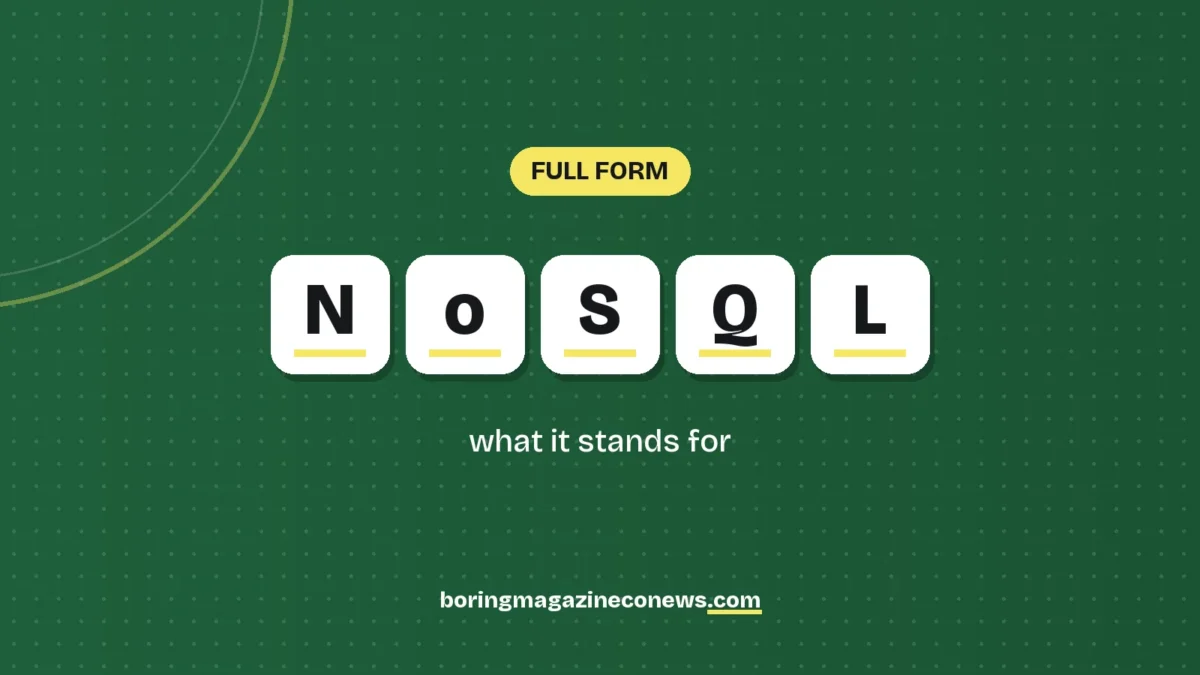
NoSQL stands for Not Only SQL, though software engineers also define it as Non-SQL to describe database systems that operate outside standard relational structures. The term indicates that an application can use structured query languages where appropriate, but can also adopt alternative architectures to store and process non-relational data. At BoringMagazine.Co, we break down essential technical terminology to help readers make sense of modern software systems. To learn more about common abbreviations used across technology and enterprise computing, check our full form reference guide.
What NoSQL Stands For
The letters in NoSQL originally represented Non-SQL when computer scientist Carlo Strozzi created a lightweight relational database in 1998 that lacked an SQL interface. Although that original software was still relational under the hood, the acronym took on an entirely different purpose a decade later. In 2009, software developer Eric Evans used the term to organize a meetup focused on emerging distributed, non-relational data stores.
Following that gathering, engineers realized that modern architectures did not need to eliminate SQL completely. Instead, developers wanted databases capable of storing unstructured or semi-structured data while scaling across distributed server clusters. Because these systems could operate alongside traditional relational tools or adopt SQL-like query interfaces, the community reinterpreted the acronym to mean Not Only SQL. Today, both interpretations exist, but Not Only SQL is the standard phrase recognized across the computing sector.
The Core Meaning and Types of NoSQL Systems
The term NoSQL describes any database engine that does not rely on the fixed tables, columns, and rows found in relational database management systems. Traditional relational systems enforce predefined schemas, requiring every record to match an exact blueprint before insertion. A NoSQL system allows developers to store diverse data shapes without declaring strict table definitions beforehand.
There are four standard categories of NoSQL databases, each built around a specific storage approach:
- Document stores: These databases store information in discrete documents, commonly formatted in JSON, BSON, or XML. Each document can maintain its own unique fields. Popular document engines include MongoDB and Couchbase.
- Key-value stores: In a key-value database, every item consists of an identifier paired with an arbitrary value. This design supports rapid read and write operations. Redis and Amazon DynamoDB serve as prominent examples.
- Wide-column stores: These systems organize data into column families instead of rigid tables. They write columns dynamically per row, which suits large analytics workloads. Apache Cassandra and Apache HBase are widely deployed wide-column stores.
- Graph databases: Graph engines store entities as nodes and relationships as edges. They excel at mapping interconnected data networks, such as fraud detection pathways and social connections. Neo4j is a common example.
Where NoSQL Is Used
Organizations deploy NoSQL solutions when their applications generate massive data volumes, require minimal latency, or process fluid data models that change often. Because NoSQL engines scale horizontally across commodity hardware nodes, teams can expand storage capacity by adding more servers rather than purchasing expensive mainframe upgrades.
Common real-world settings include:
- Content management and retail catalogs: E-commerce platforms list millions of items with varying attributes, such as clothing sizes, electronic specifications, or book formats. Document stores handle these distinct property lists without requiring thousands of blank database cells.
- Mobile apps and user profiles: Social applications demand quick authentication checks, session tracking, and user profile updates. Key-value caches deliver these lookups in single-digit milliseconds.
- Streaming logs and sensor networks: Connected devices emit steady streams of telemetry data. Wide-column stores capture millions of incoming readings every minute without stalling the application layer.
- Data analytics pipelines: Organizations frequently gather log streams into distributed storage before feeding records into statistical models, such as using an OLS linear model to evaluate trends over time.
- Information lifecycle workflows: Database administrators manage historical records according to systematic LCM schedules to archive or delete outdated customer records safely.
Real Examples of NoSQL in Action
Major online platforms rely on NoSQL databases to power daily services that billions of people use. For instance, streaming entertainment services use key-value stores to remember viewing progress across multiple devices, allowing viewers to resume a show instantly.
Financial firms employ graph databases to spot suspicious activity. By tracking transactions as connected graph nodes, compliance software detects irregular payment clusters that indicate identity theft or money laundering rings.
Logistics companies use document databases for tracking shipments. As parcels move through customs checkpoints, warehouses, and delivery vans, new status checkpoints attach to the shipment document without altering the structure of older records.
Related Terms and Concepts
Understanding NoSQL requires familiarity with several related data engineering concepts:
- RDBMS: Relational Database Management System. This traditional model organizes records into tables and relies on SQL for data definitions and queries.
- ACID: Atomicity, Consistency, Isolation, and Durability. These properties ensure database transactions remain reliable, even during power failures or system errors.
- BASE: Basically Available, Soft state, and Eventual consistency. Many NoSQL engines favor this model, prioritizing uptime and write availability over immediate data synchronization across all servers.
- CAP theorem: A foundational computer science principle stating that a distributed system can simultaneously guarantee only two out of three attributes: Consistency, Availability, and Partition tolerance.
- Sharding: The practice of splitting a large database horizontally across multiple machines to balance storage and compute demands.
FAQ
What does NoSQL stand for in full?
NoSQL stands for Not Only SQL, though it is also recognized as Non-SQL. The name highlights that modern data storage systems can handle non-relational data formats while still working alongside structured relational databases.
What is the difference between SQL and NoSQL?
The primary difference is that SQL databases store structured data in fixed relational tables, whereas NoSQL databases store semi-structured or unstructured records using documents, key-value pairs, wide columns, or graphs. SQL relies on vertical hardware scaling, while NoSQL scales horizontally across clusters.
Is NoSQL always schema-free?
NoSQL is schema-flexible rather than entirely schema-free, meaning the database engine does not enforce a rigid table structure during writes. Applications still apply internal schemas to validate information before saving or reading documents.
When should an organization choose NoSQL?
An organization should choose NoSQL when it needs to store rapid streams of unstructured data, scale across distributed cloud clusters, or deliver sub-second response times for high-traffic web applications.