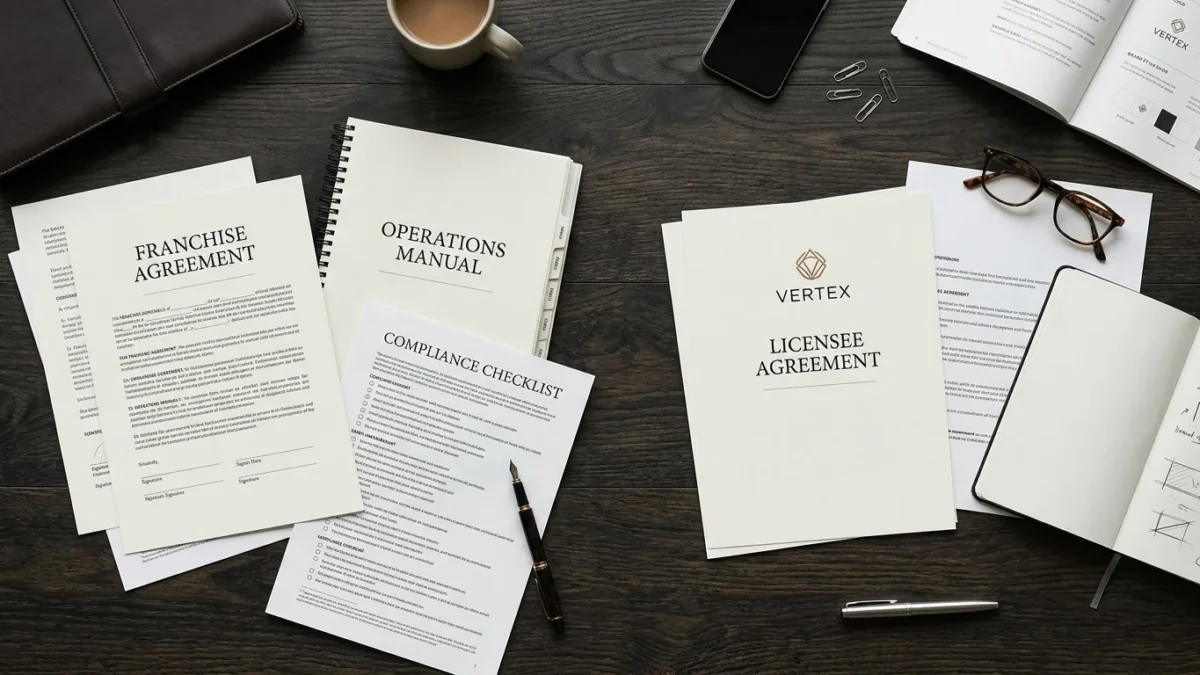
The main operational difference between a franchise and a license agreement is that a franchise imposes strict, comprehensive control over daily business operations, whereas a license agreement grants permission to use intellectual property with substantial operational autonomy. Entrepreneurs expanding a brand or launching a new location must evaluate how these two legal frameworks govern daily management, revenue sharing, and brand consistency. While both models allow an operator to commercialize intellectual property owned by another entity, their regulatory rules and day-to-day responsibilities diverge sharply. At BoringMagazine.Co, we track the structural mechanisms that shape commercial growth and contract risk.
Choosing the wrong structure can trigger severe regulatory penalties or compromise a company’s independence. A founder seeking rapid expansion without heavy supervisory overhead often prefers licensing, while a company intent on replicating a uniform customer experience across retail sites requires a franchise. Understanding these differences helps founders select the right vehicle for their capital and operational goals.
How Franchise and License Agreements Work
A franchise is an ongoing commercial relationship governed by federal and state regulations. Under rules enforced by the Federal Trade Commission (FTC), a business relationship qualifies as a franchise if it meets three statutory criteria: the distributor uses the franchisor’s trademark, the franchisor exerts significant control over or provides significant assistance to the operator’s business methods, and the operator pays a required fee of at least five hundred dollars within six months of opening. Franchisors supply a complete operating system, comprehensive manuals, site selection criteria, and mandatory supplier lists.
In contrast, a license agreement is a narrower contract centered strictly on intellectual property assets. Governed primarily by contract law and trademark standards registered with the United States Patent and Trademark Office (USPTO), a license grants a licensee the legal right to use a patent, trademark, copyright, or proprietary design. The licensor verifies that the quality of goods bearing their mark meets agreed standards, but they do not direct the licensee’s hiring policies, work schedules, retail layout, or accounting methods. For detailed guides on commercial management, explore our Business guides.
Key Operational Differences Between Franchises and Licenses
Franchisees trade personal independence for an established operating playbook. A franchisor dictates opening hours, store design, staff uniforms, technology platforms, and exact menu or service offerings. Any unauthorized deviation from the operations manual can result in default notices or contract termination. Licensees, on the other hand, retain complete operational control over their business. A sports apparel manufacturer licensing an athletic logo decides its own factory shifts, marketing campaigns, pricing strategies, and distribution channels, provided the finished products satisfy contractual quality checks.
Financial obligations also differ substantially between the two structures. Franchisees almost always pay an upfront initial franchise fee, followed by ongoing royalties calculated as a fixed percentage of gross sales, often ranging from four to eight percent. They also frequently contribute one to three percent of gross revenue to a mandatory national marketing fund, regardless of store profitability. Licensors typically charge an initial licensing fee alongside royalties tied directly to wholesale volume or units sold, rather than taxing overall gross receipts. Licensors rarely mandate collective advertising contributions.
Franchisors provide continuous operational support to ensure uniform standards across all locations. This support includes initial classroom training, on-site opening assistance, regular field audits, and centralized supply agreements. License agreements include minimal training, usually limited to technical specifications for applying the mark. When retail locations require physical commercial leases, franchisees often encounter strict site approval requirements and must handle complex property obligations like commercial CAM charges in retail leases under the franchisor’s facility rules.
Real-World Examples in Retail and Food Service
Examining well-known corporate structures illustrates how these mechanisms function in actual commerce. Fast-food chains such as McDonald’s and Subway operate primarily as franchises. When an operator buys a franchised quick-service restaurant, they purchase a complete operating blueprint. The owner must buy specified paper goods from approved distributors, prepare food according to rigid recipes, and use the exact point-of-sale software selected by corporate headquarters.
Conversely, consumer product manufacturing and entertainment merchandising frequently rely on licensing. The Walt Disney Company licenses its characters to toy makers such as Hasbro and Mattel. Disney does not manage Hasbro’s toy factories, supply chains, or employee payroll. Disney simply reviews product prototypes to ensure brand compliance, collects agreed royalty fees on wholesale shipments, and allows the manufacturer to direct its own industrial operations. Similarly, Starbucks licenses its brand to grocery distributors and university campuses, allowing those entities to operate under distinct institutional guidelines rather than standard company store operating procedures.
Common Misconceptions and Accidental Franchising
A frequent mistake among growing businesses is the belief that labeling a contract a license agreement shields them from franchise laws. Regulators evaluate the economic reality of a commercial relationship, not the title printed on the document. If a company licenses its trademark and simultaneously dictates operating hours, mandates uniform store decor, and charges an ongoing fee, the relationship constitutes what legal authorities call an accidental franchise.
Operating an unregistered franchise exposes the business to severe consequences. The FTC Franchise Rule and state franchise disclosure laws mandate that franchisors provide a detailed Franchise Disclosure Document (FDD) at least fourteen days before accepting money or signing binding contracts. Failing to provide this document gives operators the right to rescind agreements, demand full refunds of all fees paid, and pursue statutory damages. Companies drafting commercial contracts must also pay close attention to indemnification clauses in commercial contracts to ensure liabilities arising from brand misuse or regulatory non-compliance are properly allocated between the parties.
Legal Protections and Professional Guidance
Because commercial contracts create long-term financial commitments, business owners must seek professional legal and accounting counsel before executing either document. Franchise agreements are notoriously rigid, offering little room for individual negotiation, and they impose personal guarantees that put personal assets at risk if the unit underperforms. A specialized franchise attorney can review the franchisor’s disclosure documents, examine litigation history, and clarify territorial protections.
Licensing agreements require intellectual property specialists who can establish clear boundaries around trademark use, territorial exclusivity, and quality inspection audits. A certified public accountant should model cash flows under both scenarios, factoring in mandatory royalty payments, inventory overhead, and local tax requirements. The information presented here serves as general business education and does not constitute formal legal or financial advice. Every prospective operator must consult qualified professionals to evaluate their specific market circumstances.
FAQ
Can a licensing agreement legally turn into a franchise?
Yes, a licensing agreement legally becomes an accidental franchise if the licensor exercises significant operational control and collects substantial fees. State and federal regulators look past contract titles to evaluate whether a trademark, operational control, and required payments exist together. If all three elements are present, the licensor must comply with federal franchise disclosure regulations.
Which business model costs less to start and maintain?
A license agreement generally costs significantly less to start and maintain than a franchise because it avoids complex regulatory filings and rigid system mandates. Franchisors must spend substantial sums preparing and updating annual disclosure documents, conducting field audits, and providing ongoing support infrastructure. Licensees also avoid mandatory national marketing fees and strict capital reinvestment schedules.
Do licensees have to follow a specific operating manual?
No, licensees typically do not follow an operating manual because licensors license rights to intellectual property rather than dictating day-to-day business methods. The licensor only monitors product quality and brand presentation to protect trademark validity under federal intellectual property laws. All daily procedures, staffing decisions, and operational systems remain entirely under the licensee’s independent discretion.