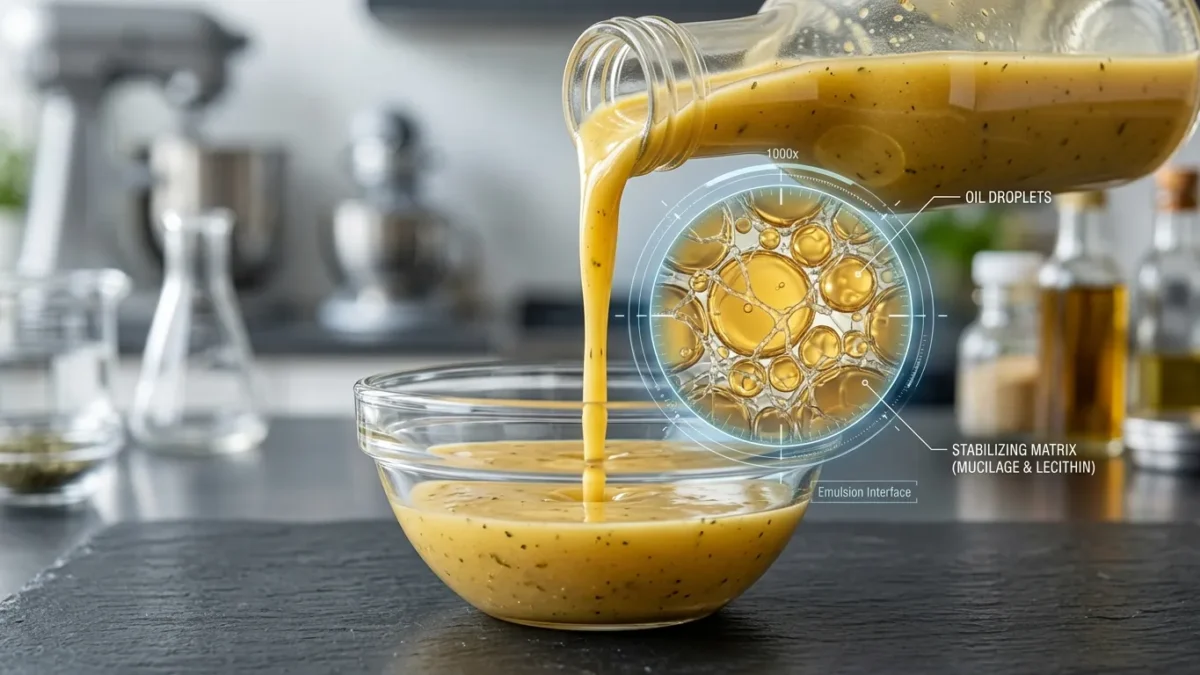
Emulsifiers work in salad dressing by using molecules with both water-attracting and oil-attracting ends to bridge the chemical gap between oil and water, keeping them from separating into distinct layers. When you mix oil and vinegar without a stabilizer, the liquids part ways within minutes. At BoringMagazine.Co, we explain everyday kitchen science so you understand how basic culinary reactions happen. In this guide, you will learn how molecules in egg yolks and mustard seeds hold suspensions together.
The Chemistry of Oil and Water in Salad Dressing
To understand why dressings split, you must look at molecular bonds. Vinegar is mostly water, with about five percent acetic acid. Water molecules are polar, meaning they carry a positive charge at one end and a negative charge at the other. Because opposite charges attract, water molecules cling to one another through strong hydrogen bonds. They form an organized, tightly bonded network.
Culinary oils consist of triglycerides, which are nonpolar molecules. Their electrons are distributed evenly, so they carry no electrical charge. Because they lack charge, oil molecules cannot form hydrogen bonds with water. Instead, the polar water molecules pull together and exclude the oil. Food scientists refer to this behavior as the hydrophobic effect.
Cooking oil is also less dense than water. Once excluded from the water network, oil droplets float upward and coalesce into an unbroken layer. Shaking creates tiny droplets temporarily, but surface tension quickly draws the water back together.
How Surface-Active Molecules Prevent Separation
A salad dressing is typically an oil-in-water emulsion. The vinegar serves as the continuous phase, while microscopic oil droplets act as the dispersed phase. Left alone, these two liquids cannot stay combined.
Emulsifiers are surface-active molecules, or surfactants. They are amphiphilic, which means they contain two chemically distinct parts. One end is hydrophilic, or water-loving. This polar head carries a charge that bonds easily with water. The opposite end is lipophilic, or oil-loving. This nonpolar tail consists of hydrocarbon chains that dissolve into fats.
When you whisk an emulsifier into vinegar and oil, these molecules arrange themselves along the boundary between the liquids. The lipophilic tails embed into the oil droplets, while the hydrophilic heads stick outward into the water. This coating lowers surface tension. Because the exposed heads carry similar charges, neighboring oil droplets repel each other instead of merging.
Egg Yolks and Mustard: Two Culinary Emulsifiers Compared
Home cooks rely on different ingredients to stabilize dressings. Two of the most common are egg yolks and prepared mustard, though each works through a distinct mechanism.
Egg yolks contain lecithin, a group of phospholipids dominated by phosphatidylcholine. A phospholipid features two fatty acid tails and a charged phosphate head. In mayonnaise and creamy dressings, lecithin coats oil droplets with extreme efficiency. A single egg yolk can hold several cups of oil in suspension if whisked properly.
Prepared mustard stabilizes dressings through a compound called mucilage. Mucilage is a complex polysaccharide stored in the seed coat of mustard seeds. It does not act as a classic phospholipid surfactant. Instead, it absorbs liquid and swells, which raises the viscosity of the vinegar base. The thickened liquid slows droplet movement, while proteins from the ground seed coat gather at droplet boundaries to physically block coalescence.
Both ingredients create stable dressings, but they yield different textures. Egg yolks create rich, creamy emulsions, while mustard creates light, pourable vinaigrettes.
Step-by-Step Mechanics of Building a Stable Emulsion
Chemical emulsifiers require mechanical energy to divide large pools of oil into microscopic spheres. Following specific steps ensures that the suspension forms properly:
- Combine the continuous phase first: Place your vinegar, salt, and chosen emulsifier in a bowl. Whisk until the emulsifier dissolves or blends evenly.
- Add oil drop by drop: Introduce the oil very slowly while whisking vigorously. The whisk wires apply shear force, breaking the oil stream into microscopic droplets. Adding too much oil early coats the whisk and ruins droplet formation.
- Watch for thickening: As you whisk, the liquid will turn opaque and thicken. This visual change confirms that coated droplets have formed.
- Pour the remaining oil in a thin stream: Once the emulsion forms, you can pour the rest of the oil in a steady stream while whisking continuously.
- Adjust temperature and liquid balance: Room temperature ingredients blend faster than cold ingredients because fluid oils break down easily. As shown in our Food guides, physical conditions shape how culinary liquids act. For details on heat and cooking fats, see our cooking oil smoke point breakdown.
Common Mistakes That Cause Dressings to Break
An emulsion breaks when droplets overcome their barriers and fuse back together. Avoiding these common mistakes keeps your dressing smooth:
- Adding oil too fast: Flooding the bowl creates large oil pools that cannot be broken down, overwhelming the emulsifier.
- Using too little water: An oil-in-water emulsion needs enough continuous liquid for droplets to move freely. If oil exceeds four parts to one part water by volume, the droplets crowd and collapse.
- Relying only on shaking: Shaking a jar creates a temporary dispersion, not an emulsion. Without surface-active molecules, surface tension separates the liquids in minutes.
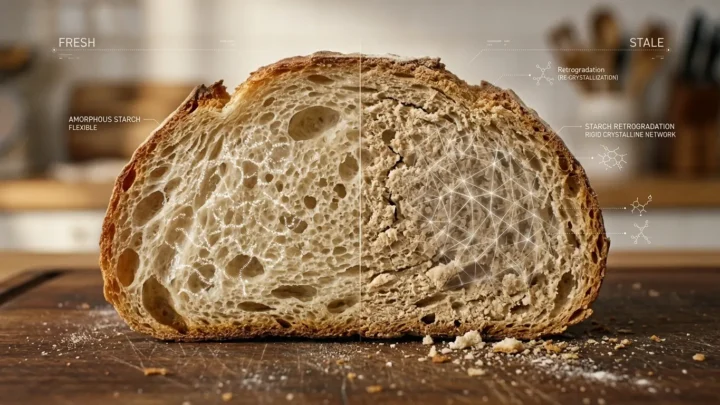
- Confusing starch thickness with emulsification: Starch pastes can thicken liquids, but starches work through gelatinization rather than surface chemistry. For more on starch behavior, review our article on why cooked starch goes stale.
- Storing in cold temperatures: Olive oil solidifies in cold refrigerators. Solid fat crystals pierce the protective film around droplets, causing separation when brought back to room temperature.
FAQ
Why does my vinaigrette separate after a few hours?
Your vinaigrette separates because it lacks an effective chemical emulsifier or was not whisked with enough shear force to create microscopic droplets. Without amphiphilic molecules to lower surface tension and create repulsive charges, the natural attraction between polar water molecules pushes nonpolar oil to the top.
Can you fix a broken salad dressing?
You can fix a broken salad dressing by whisking a teaspoon of water and a dab of mustard in a fresh bowl and slowly beating the broken mixture into it. The fresh liquid and emulsifier establish a new continuous base that re-disperses the separated oil into a stable suspension.
Are culinary emulsifiers safe for people with food allergies?
Culinary emulsifiers like egg yolks and mustard seeds are standard food ingredients, but both are recognized allergens capable of causing adverse reactions in sensitive people. Readers with suspected food allergies should consult a qualified doctor or allergist for testing and guidance before eating dressings containing these ingredients.