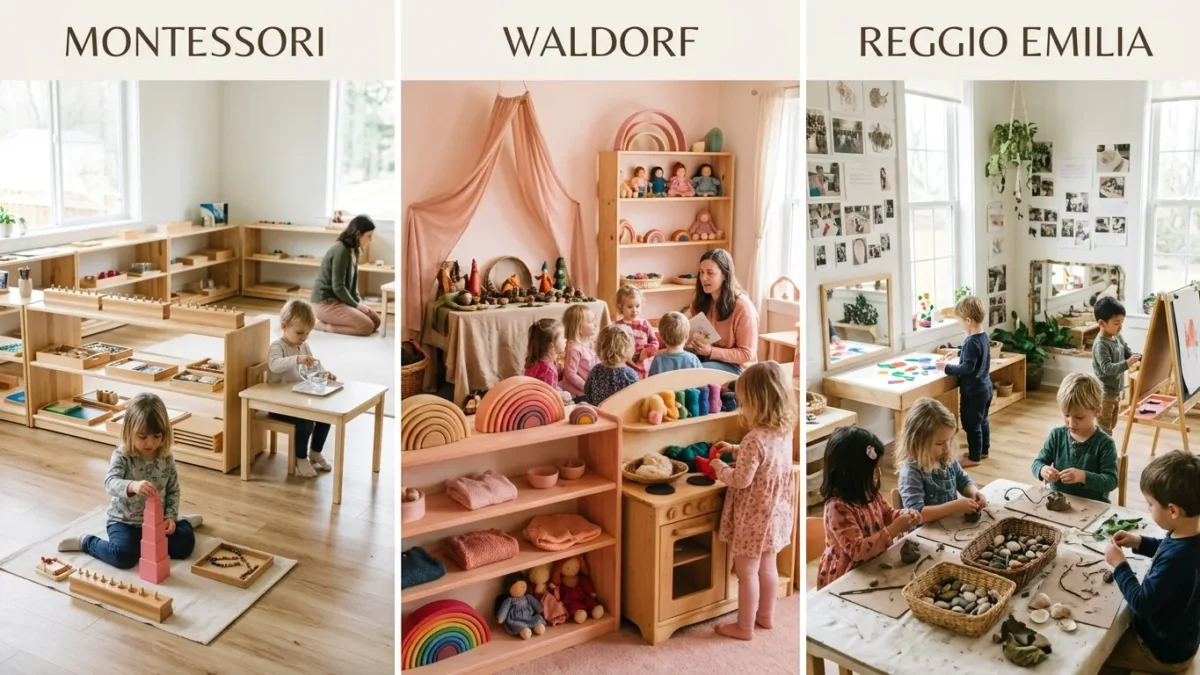
The primary difference between Montessori, Waldorf, and Reggio Emilia education lies in their core focus: Montessori prioritizes self-directed learning with structured didactic materials, Waldorf emphasizes imagination and arts-infused anthroposophical rhythms, and Reggio Emilia centers on collaborative, project-based inquiry guided by an emergent curriculum.
All three progressive early learning approaches originated in twentieth-century Europe as alternatives to conventional schooling. While all three philosophies respect early childhood and encourage self-reliance, they structure the school day, the physical environment, and teacher duties differently. Families looking for educational insight can turn to BoringMagazine.Co to evaluate alternative school structures and select an environment suited to their child.
Foundational Philosophy: How Each Model Works
Dr. Maria Montessori founded her method in Rome in 1907. Her design rests on the premise that children possess an innate drive to learn when placed in an orderly environment. Montessori classrooms feature multi-age groupings spanning three-year bands, such as ages three to six. Students engage in uninterrupted work periods, independently choosing activities from low shelves. The Association Montessori Internationale, accessible through AMI, supports this model of hands-on, self-directed learning.
Rudolf Steiner founded Waldorf education in Germany in 1919, based on his philosophy of anthroposophy. Waldorf divides child development into seven-year cycles. The early childhood phase, from birth to age seven, focuses on physical imitation, sensory engagement, and imaginative play. Waldorf classrooms prioritize domestic arts, seasonal rhythms, circle games, and oral storytelling without digital screens. Regional standards are supported by the Association of Waldorf Schools of North America.
Reggio Emilia arose in northern Italy following World War II. Educator Loris Malaguzzi partnered with local families to build a cooperative approach rooted in community solidarity. The model views children as competent, curious researchers. Instead of following a preset syllabus, teachers develop an emergent curriculum based on children’s questions and play. The philosophy recognizes one hundred languages, encouraging children to express ideas through drawing, sculpting, and building.
Key Differences in Learning Materials and Curriculum Design
Classroom materials reflect the core philosophical differences among the three traditions.
Montessori classrooms supply specific didactic materials that are self-correcting. Tools like cylinder blocks, the pink tower, and sandpaper letters feature an internal control of error. When a child inserts a wooden cylinder into the wrong socket, the piece sticks out, signaling an error without adult correction. Practical items like small glass pitchers replace fantasy toys because reality takes precedence in early childhood.
Waldorf classrooms select open-ended, natural play materials. Shelves contain hand-dyed silks, unpainted wood, wool yarn, pinecones, and simple handmade dolls without facial features. These neutral items allow children to transform simple wood into a boat or a house. Early literacy and arithmetic wait until first grade, relying instead on oral verse and puppetry.
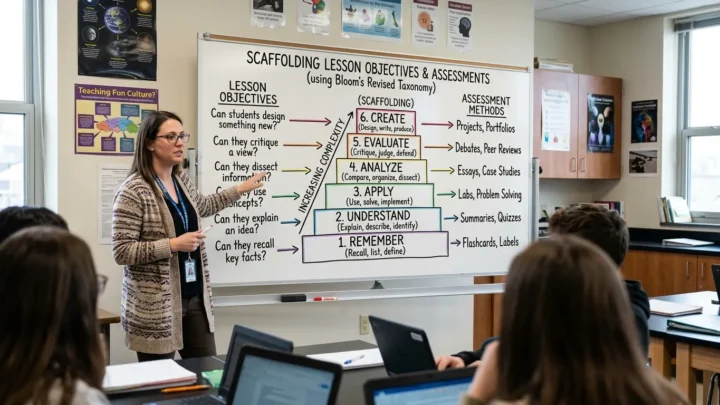
Reggio Emilia classrooms feature loose parts alongside artistic media. Children work with clay, charcoal, light tables, and mirrors to test ideas. Just as instructors scaffold lesson objectives using Bloom’s Taxonomy to guide cognitive progression, Reggio educators introduce materials in direct response to children’s developing hypotheses.
The Teacher’s Role and Social Environment
Teacher roles differ across all three systems, shaping social interaction.
In Montessori, the teacher acts as an unobtrusive guide. The educator presents brief individual lessons, then steps back to observe silently. Social interaction occurs naturally, though children often work individually on floor mats, prioritizing personal concentration and practical task mastery.
In Waldorf, the teacher is an authoritative figure directing group life. Children gather for communal circle times, share bread baking, and clean together. Imitation is the primary learning vehicle, so the teacher models graceful movements and domestic work, often staying with the same cohort for multiple years.
In Reggio Emilia, the teacher acts as a co-learner and research partner. Educators work in pairs, recording children’s discussions with notebooks and cameras. They review this documentation to pose questions that sustain student investigations, keeping small-group collaboration constant.
Daily Classroom Routines in Practice
A look at a typical morning highlights the practical differences families encounter across these schools.
- A Morning in Montessori: A child arrives at 8:30 AM, hangs up his coat, and selects a tray from the math shelf. He sits on his work rug to count glass beads. Later, he slices an apple to share with a peer, completing three uninterrupted hours of self-chosen work.
- A Morning in Waldorf: Children enter a warm room scented with fresh bread. They gather in a circle to sing seasonal verses led by the teacher. After outdoor play, the children sit together to eat warm porridge and listen to an oral folk tale told from memory.
- A Morning in Reggio Emilia: Children begin by discussing a bird nest found on the playground. Gathering around a light table, they examine feathers and share theories. The teacher provides clay and wire so pairs of students can sculpt their interpretations while educators photograph their progress.
For parents comparing early learning methods with broader educational tracks, our Education guides provide detailed evaluations of instructional models and academic frameworks.
Common Misconceptions About These Early Childhood Methods
Parents researching alternative schooling frequently encounter common assumptions regarding structure and academic readiness.
A frequent misconception is that Montessori classrooms discourage socialization because children work on individual mats. While children work independently to build focus, they freely converse, assist younger classmates, and cooperate on shared classroom maintenance, building intrinsic social responsibility.
Another misconception suggests Waldorf programs are academically deficient because reading instruction begins at age seven. Delaying desk work allows children to establish strong physical, sensory, and emotional foundations. When formal reading begins, children progress quickly through rich oral vocabularies and deep story comprehension.
Some critics assume Reggio Emilia lacks discipline because it follows an emergent curriculum without a fixed textbook. In reality, Reggio projects require careful organization, deliberate teacher planning, and sustained analytical focus. Teachers spend significant time interpreting records and designing intentional classroom provocations.
FAQ
Which method is best for an active or energetic child?
Montessori and Reggio Emilia are often suitable for energetic children because both allow regular physical movement throughout the room rather than mandatory seated group lessons. In Montessori, children walk between shelves, carry trays, and sweep floors. In Reggio Emilia, children collaborate on large art and construction projects. Waldorf also values physical activity through outdoor play, though indoor routines require sustained group participation in teacher-led circles.
Are reading and math taught early in these schools?
Montessori introduces reading, writing, and arithmetic earliest among the three philosophies, often beginning systematically around age three or four. Children trace sandpaper letters, blend phonics sounds, and calculate place value using bead materials. Waldorf postpones direct academic instruction until first grade, focusing early childhood on spoken vocabulary, puppetry, and fairy tales. Reggio Emilia introduces literacy and numeracy naturally whenever measurements or letters support an ongoing project.
Can children easily transition to conventional schools later?
Children from all three models generally adjust well to conventional elementary schools once they become familiar with standard classroom schedules. Montessori graduates possess strong time management skills, self-discipline, and independent study habits. Waldorf alumni typically bring rich verbal communication and creative problem-solving skills, though they may need time to adjust if standardized testing starts abruptly. Reggio Emilia students excel in collaborative group projects, creative research tasks, and analytical reasoning.