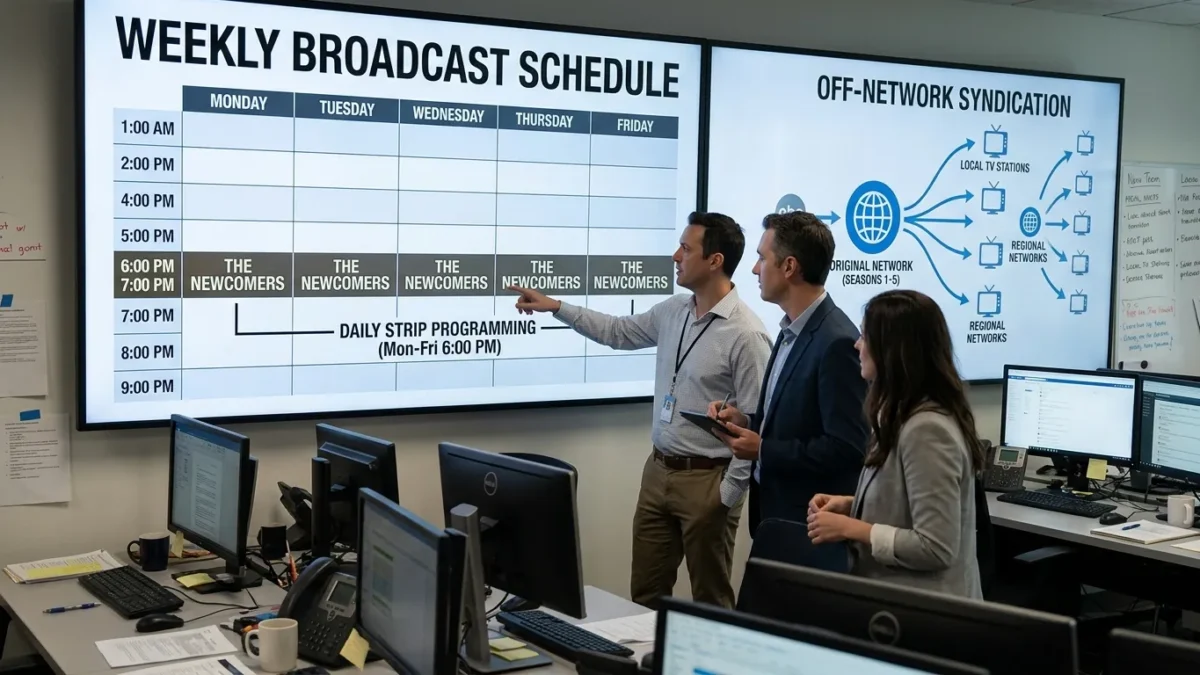
Television syndication works by licensing broadcast rights for television programs directly to individual local stations, cable channels, and regional networks rather than distributing them through a single parent network. Instead of relying on a national network schedule, syndicators sell individual shows market by market. This distribution model supplies local stations with hours of daily programming and gives producers a direct path to long-term profitability.
At BoringMagazine.Co, we analyze the business mechanics behind media distribution. In this guide, we break down how off-network syndication functions, why local television stations rely on strip programming, and how licensing deals divide advertising revenues.
Understanding Off-Network Syndication and Strip Programming
Off-network syndication refers to the sale of program reruns that originally aired on a broadcast network, cable channel, or streaming platform. After a scripted sitcom or one-hour procedural completes its original run, the studio packages past seasons and sells broadcast rights to independent stations and network affiliates across individual media markets. Media research firms rank these local markets as Designated Market Areas, allowing distributors to negotiate separate rights in New York, Chicago, and small regional markets simultaneously.
Strip programming is the scheduling strategy that drives this market. While original network series air once a week, local stations broadcast syndicated reruns in strip scheduling, meaning the same show airs in the same time slot five days a week, Monday through Friday.
Stations use strip programming to create consistent viewing habits. Audiences tuning in before evening news or during late afternoon hours know what to expect, providing local broadcasters with reliable ratings and dependable commercial inventory.
The 100-Episode Benchmark and Syndication Math
The math of five-day strip programming explains why studios historically aimed for one hundred episodes. When a station airs a show every weekday, it runs through five episodes each week, or twenty episodes per month.
A series with only twenty-two episodes would exhaust its run in just over a month. Repeating that modest batch year-round causes rapid viewer fatigue, leading to declining ratings and lower ad rates.
Reaching one hundred episodes supplies twenty weeks of weekday programming. A station can cycle through the full catalog roughly twice per year, leaving room for sports broadcasts, seasonal specials, or occasional preemptions.
Although some digital outlets accept smaller packages, one hundred episodes remains the historical benchmark that transforms an expensive production into a profitable catalog asset. As episodes air repeatedly across hundreds of markets, studios monitor musical rights through broadcast cue sheets; read how music cue sheets track broadcast royalties to see how performance rights groups compensate composers during syndicated runs.
Station Broadcast Licensing Packages and Ad-Revenue Splits
When syndicators and local stations negotiate broadcast deals, they structure agreements around three primary licensing models:
- Cash Licensing: The station pays a predetermined fee upfront for exclusive local broadcast rights over a set term. The station keeps all commercial airtime and retains one hundred percent of local ad revenue.
- Straight Barter: The station pays no upfront licensing fee. The syndicator retains several commercial minutes per episode to sell to national advertisers, while the station sells the remaining ad slots locally.
- Cash-Plus-Barter: The station pays a reduced cash fee while sharing commercial airtime with the distributor. Both parties split the advertising inventory.
For example, in a half-hour broadcast with six minutes of total advertising, a cash-plus-barter contract might allocate four minutes to the local station for area businesses, while leaving two minutes for the syndicator to place national consumer brand commercials.
These contracts define license duration, allowable runs per episode, and territorial exclusivity, preventing rival local stations from airing the same series. The Federal Communications Commission sets broad station operating standards, but financial terms remain private agreements between distributors and station owners.
First-Run Versus Off-Network Syndication
Syndicated programming falls into two distinct categories based on production history:
First-run syndication features programs produced specifically for direct sale to local stations without an initial network run. Daily talk shows, court programs, and popular game shows like Wheel of Fortune and Jeopardy! operate under this model. These productions create fresh episodes throughout the year for daytime and early fringe time slots.
Off-network syndication involves series that previously built an audience on prime-time network television. Sitcoms like The Big Bang Theory and procedurals like Law & Order enter this market after establishing strong viewer familiarity. Stations purchase these packages to draw consistent lead-in audiences for late local newscasts.
To learn more about technical production and visual standards, explore our Entertainment guides.
Real Examples: The Economics of Syndication Hits
Few distribution models equal the financial returns of a successful syndicated comedy. Half-hour sitcoms perform best because their episodic nature allows viewers to enjoy random installments without tracking continuous story arcs.
I Love Lucy pioneered rerun distribution in the 1950s by recording on high-grade 35mm film instead of low-resolution kinescope. That decision preserved pristine visual masters, enabling continuous syndication for generations.
Later hits like Seinfeld and Friends generated billions of dollars in off-network licensing fees. Studios licensed these catalogs across hundreds of broadcast markets, generating profits far beyond initial network licensing revenue.
Hour-long dramas follow a distinct syndication pattern. While sitcoms dominate afternoon strip slots, procedural dramas excel in weekend syndication blocks and late-night scheduling, where viewers appreciate self-contained mystery plots that resolve in a single broadcast hour.
Common Misconceptions About Television Syndication
Several misconceptions surround the syndicated television market:
- Syndication signals a canceled show: Reaching syndication is a major financial milestone for producers, often generating the highest profit margins of a series’ lifecycle.
- Streaming eliminated broadcast syndication: While streaming provides on-demand access, local broadcast stations still rely heavily on syndicated strip programming to generate vital local advertising revenue.
- Networks control all station programming: Local network affiliates are frequently owned by independent broadcasting companies that purchase syndicated packages separately from their primary network affiliations.
FAQ
What is strip programming in television?
Strip programming is a scheduling method where a station broadcasts the same television series in the same time slot every Monday through Friday. This consistent schedule builds daily viewing habits and delivers steady audience numbers for local advertisers.
Why do television shows need 100 episodes for syndication?
A television series needs roughly 100 episodes so a station can air one episode each weekday for twenty weeks without repeating content. This library size prevents audience fatigue by limiting repeats to roughly twice per calendar year.
How do television stations make money from syndicated reruns?
Television stations make money from syndicated reruns by selling commercial slots within each episode to local and regional advertisers. Stations retain all commercial revenue under cash licensing deals or share advertising inventory with syndicators under barter arrangements.