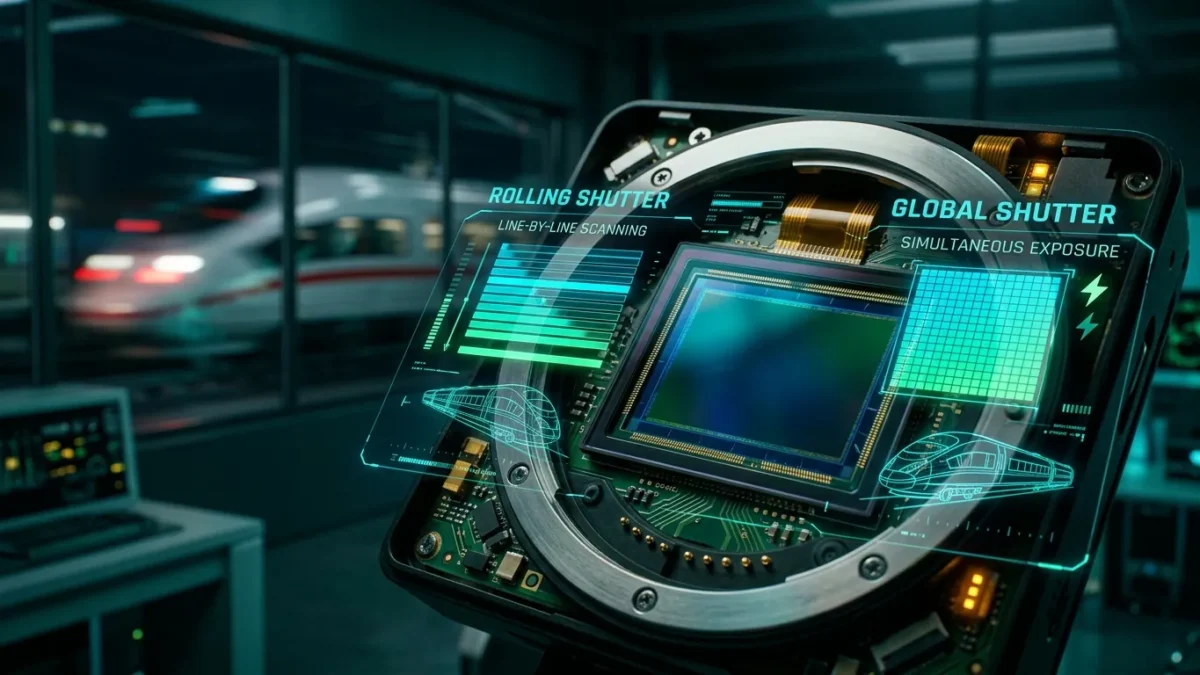
When comparing rolling shutter vs global shutter, the fundamental difference is that a rolling shutter exposes and reads a sensor row by row over several milliseconds, while a global shutter exposes every pixel across the entire sensor simultaneously. This distinction dictates how digital cameras record motion, handle high-speed action, and preserve straight vertical lines in video production.
Digital sensors form the backbone of modern cinematography, and understanding sensor hardware helps filmmakers choose the right equipment. Readers exploring camera mechanics on BoringMagazine.Co often ask why fast camera movements bend background objects. You can discover more camera and production breakdowns in our Entertainment guides, which cover gear choices and visual storytelling techniques.
To understand why physical distortions occur, one must examine how digital light sensors transfer optical information into recorded video frames.
How Rolling Shutter and Global Shutter Sensors Work
Most digital cameras use complementary metal-oxide-semiconductor sensors, commonly known as CMOS sensors. A CMOS sensor contains millions of light-sensitive photodiode sites arranged in a grid of horizontal rows and vertical columns.
In a rolling shutter system, the camera does not capture the entire scene at a single instant. Instead, exposure begins at the top row of pixels and sweeps downward row by row. Each individual row exposes for the duration set by the shutter speed, and the camera circuitry reads out the voltage from that row before moving to the next. Although this sweep happens within a fraction of a second, typically taking between five and thirty milliseconds depending on the camera, the top and bottom of the frame are recorded at distinct points in time.
In contrast, a global shutter system exposes every pixel across the entire sensor at the exact same moment. When exposure ends, the electronic charge in each photodiode is shifted into dedicated storage nodes next to each pixel. The camera then reads the stored data row by row, but the optical information represents a single, uniform slice of time.
Key Differences Between Rolling and Global Shutters
The choice between row-by-row scanning and simultaneous capture introduces distinct engineering trade-offs. Neither sensor architecture is superior in every scenario, because each offers specific operational benefits.
The primary differences include:
- Exposure timing: Global shutters record every pixel during the exact same microsecond, while rolling shutters expose rows across a staggered time window.
- Strobe lighting and flash synchronization: Camera flashes and lightning discharge over a few milliseconds. A rolling shutter captures this light on only some pixel rows, producing split-screen flash banding. A global shutter captures the flash across the full frame.
- High-speed motion fidelity: Rapidly moving subjects maintain physical proportions with a global shutter, whereas rolling shutters create diagonal skew during quick pans.
- Dynamic range and low-light noise: Global shutter sensors require extra memory components inside each pixel site. These components consume silicon space, reducing the light-gathering area of each diode. Rolling shutter sensors offer larger photodiode areas, delivering broader dynamic range and lower noise in dim light.
- Manufacturing expense and power draw: Global shutter sensors run hotter, drain batteries faster, and cost more to produce than standard rolling shutter chips.
The Mechanics of Rolling Shutter Distortion
Rolling shutter distortion occurs because physical objects or the camera move during the time interval between the readout of the top row and the bottom row. If something shifts position during this readout window, the camera captures it at different coordinates across consecutive scan lines.
This timing delay creates several recognizable visual distortions:
- Straight-line skew: When panning across vertical subjects like light poles or fences, the camera points further sideways by the time it scans the lower rows. This turns vertical lines into diagonal slants.
- Jello wobble: High-frequency vibrations from vehicle mounts or drone propellers shake the camera back and forth multiple times during a single frame readout. As different rows shift in opposite directions, the footage exhibits an unnatural rubbery wobble.
- Spatial compression and stretching: Objects moving in the direction of the downward sensor scan stay under the active lines longer and appear stretched. Objects moving against the scan pass active lines quickly and appear squashed.
- Rotational curvature: Fast-spinning objects like airplane propellers and fan blades move through substantial angles between row readouts, rendering straight blades as curved arcs.
Real-World Examples in Film and Video Production
Sensor readout timing directly influences visual results on professional film sets, especially during dynamic action scenes.
In action filmmaking, rapid whip pans help track fast movements or transition between shots. When an operator whip pans a rolling shutter camera past indoor sets, background walls and doorways bend noticeably. Just as pairing anamorphic lenses and aspect ratios changes horizontal geometry and bokeh, selecting camera sensors dictates how straight lines hold their form during rapid camera movement.
Aerial filming and automotive tracking offer another visible demonstration. Helicopter rotors recorded on rolling shutter cameras appear as detached curved blades instead of straight spinning discs. Tracking shots of passing cars can turn round wheels into tilted ovals and bend passing street lamps backward.
Cinematographers frequently apply creative looks to raw footage, as detailed in our breakdown of what a LUT is in video editing. However, color pipelines cannot alter hardware sensor timing, meaning skew must be managed directly on set.
Common Misconceptions About Shutter Speed and Sensor Readout
Many videographers confuse exposure duration with sensor readout speed. Understanding how these settings interact helps avoid unexpected distortions.
The most common mistake is assuming that increasing shutter speed eliminates rolling shutter skew. Shutter speed determines how long each individual pixel gathers light. If a sensor takes fifteen milliseconds to read from top to bottom, setting the shutter speed to 1/1000 of a second simply produces razor-sharp individual lines. The total sweep time remains fifteen milliseconds, so vertical objects tilt at the exact same angle.
Another misunderstanding involves frame rates. Shooting at 24 frames per second does not mean the readout takes 1/24 of a second. High-performance sensors can scan the image in eight milliseconds and remain idle until the next exposure. High frame rates like 120 frames per second require fast readout, but the underlying row-by-row mechanism remains present.
Finally, some shooters assume digital post-production stabilization can effortlessly fix jello artifacts. While software can steady overall camera drift, correcting complex row-by-row oscillation often introduces blurred boundaries and perspective warping.
FAQ
Can a fast shutter speed fix rolling shutter distortion?
No, a faster shutter speed will not eliminate rolling shutter distortion because shutter speed only controls the exposure duration of each individual row, not the total time it takes the sensor to read from top to bottom. Even at 1/2000 of a second, a sensor may still require fifteen milliseconds to complete its downward sweep, preserving the tilt on fast-moving subjects. To minimize distortion, operators should use wider lenses, pan smoothly, or select cameras with faster readout speeds.
Why do most modern video cameras still use rolling shutters?
Most modern video cameras use rolling shutters because CMOS sensors with rolling readout offer higher dynamic range, lower digital noise, and lower manufacturing costs than global shutter sensors. Adding physical storage capacitors to each pixel for global exposure takes up space that would otherwise collect incoming light. As manufacturers develop faster rolling readout circuits that scan frames in under six milliseconds, distortion becomes negligible for most filming applications.
Can video editing software completely repair rolling shutter wobble?
Video editing software can reduce mild rolling shutter skew using digital motion tracking algorithms, but software fixes cannot fully restore complex geometric warping or artifacts from unpredictable camera shake. Dedicated rolling shutter repair plugins track camera motion and shift pixel rows back into position. However, severe jello effects from motor vibrations or erratic movements usually result in resolution loss and unnatural stretching.