Using Bloom’s taxonomy in lesson planning means ordering learning objectives and assessments by cognitive complexity, moving students systematically from foundational recall to complex evaluation and creative production. In 2001, Lorin Anderson and David Krathwohl updated Benjamin Bloom’s original 1956 framework. They converted the static nouns into active verbs and shifted the highest category from evaluation to creation. At BoringMagazine.Co, we focus on practical systems that help teachers organize everyday instruction. By structuring lessons around these cognitive categories, educators ensure that students master basic facts before tackling abstract problem-solving.
Understanding the Six Cognitive Levels of Revised Bloom’s Taxonomy
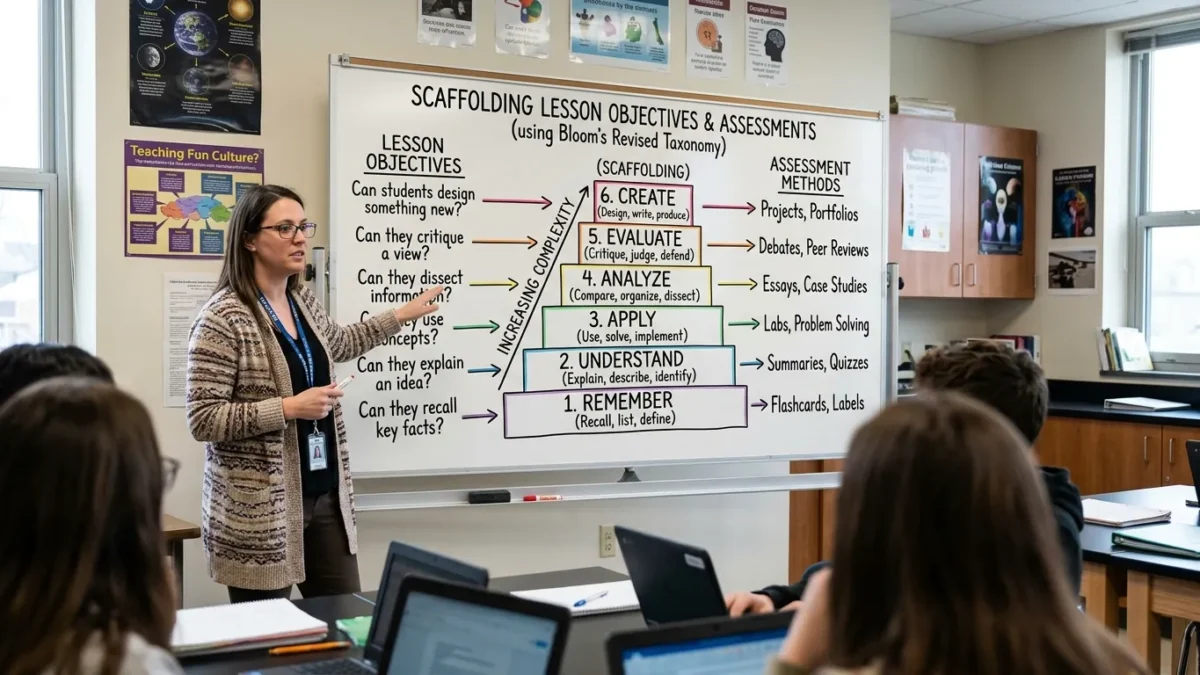
The revised taxonomy arranges cognitive processes into a six-level hierarchy. Each tier represents a distinct type of thinking that builds directly on the levels below it.
Level one is Remembering. At this stage, students retrieve, recognize, and recall relevant knowledge from long-term memory. Tasks include defining terms, reciting dates, or identifying basic parts of a system.
Level two is Understanding. Learners construct meaning from instructional messages by interpreting, exemplifying, classifying, summarizing, inferring, comparing, or explaining. This step moves beyond rote memorization to demonstrate basic comprehension.
Level three is Applying. Here, students carry out or use a procedure in a given situation. They execute familiar tasks or apply formulas and rules to solve new problems.
Level four is Analyzing. Students break material into its constituent parts and determine how the parts relate to one another and to an overall structure. This involves differentiating relevant from irrelevant facts, organizing data, and attributing underlying bias or purpose.
Level five is Evaluating. Learners make judgments based on criteria and standards through checking and critiquing. They defend positions, judge the credibility of sources, and detect logical fallacies.
Level six is Creating. As the pinnacle of the revised framework, creating requires putting elements together to form a coherent or functional whole, or reorganizing elements into a new pattern or structure.
Selecting Action Verbs to Write Measurable Objectives
Clear lesson objectives require observable, measurable student actions. Generic terms like “understand,” “know,” or “learn” make it difficult to determine whether a student has reached mastery. Bloom’s taxonomy solves this ambiguity by pairing each cognitive tier with specific operational verbs.
When designing objectives, educators select verbs that clearly define what students will produce:
- Remembering: list, identify, recall, name, define, recite, label.
- Understanding: summarize, explain, classify, paraphrase, illustrate, compare.
- Applying: calculate, solve, demonstrate, modify, operate, execute.
- Analyzing: categorize, differentiate, deconstruct, compare, examine, contrast.
- Evaluating: judge, critique, justify, defend, rate, assess.
- Creating: design, construct, formulate, author, compose, develop.
Using these verbs helps teachers write objectives using established standards such as the SWBAT format (“Students Will Be Able To”). For instance, writing “students will identify three branches of government” establishes a clear threshold for assessment, whereas “students will learn government” remains vague.
How to Scaffold Learning Sequences Across Cognitive Tiers
Scaffolding is the instructional practice of providing temporary supports to students as they acquire new skills and gradually removing those supports as competence grows. Within our Education guides, lesson scaffolding often mirrors cognitive taxonomies.
To scaffold effectively, instructors begin instructional units with foundational knowledge before introducing analytical tasks. A teacher introduces key terminology, formulas, and facts during direct instruction. Once students prove recall, guided practice shifts toward understanding and application through structured worksheets and guided problem sets.
Independent practice pushes students into analysis and evaluation. Working individually or in collaborative teams, students examine case studies, compare alternative solutions, and defend their conclusions. This progression ensures students never confront high-level tasks without the prerequisite vocabulary and operational rules.
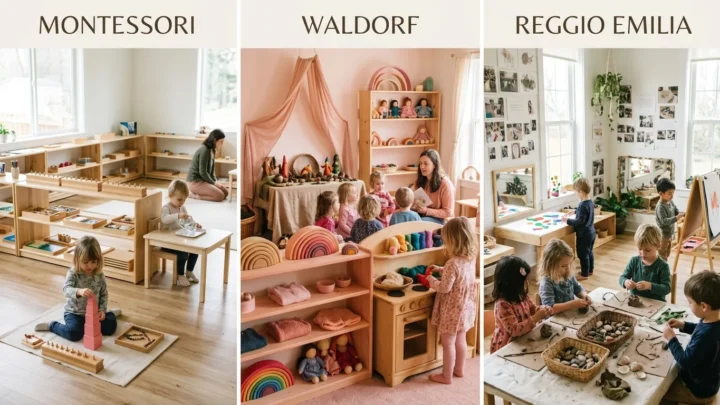
Curriculum design often blends cognitive scaffolding with broader pedagogical traditions. For example, comparing core classroom philosophies like Montessori and Waldorf shows how different schools structure independent discovery and teacher guidance across grade bands. Regardless of school model, cognitive scaffolding keeps daily lessons focused on clear steps of mastery.
Matching Formative and Summative Assessments to Cognitive Demand
An effective lesson plan maintains tight alignment between stated learning objectives and assessment methods. If a lesson objective targets evaluation, an assessment asking solely for multiple-choice definitions creates an alignment mismatch.
Formative assessments monitor ongoing progress and target lower to intermediate cognitive tiers:
- Quick checks, flashcards, and recall quizzes measure remembering.
- Exit tickets asking students to explain a concept in their own words measure understanding.
- Problem sets and lab procedures measure application.
Summative assessments evaluate cumulative learning and usually demand higher-order thinking:
- Comparative essays and data analysis tasks measure analysis.
- Debates, peer reviews, and critique rubrics measure evaluation.
- Portfolios, original experiments, and research proposals measure creation.
Proper alignment prepares secondary students for standardized collegiate benchmark tests. When schools align course assessments with higher cognitive tiers, students perform better on complex evaluations, such as those seen in AP and IB exam scoring and college credit expectations.
Step-by-Step Example of a Bloom’s Taxonomy Lesson Unit
To see how Bloom’s revised taxonomy works in practice, consider a secondary biology unit on ecosystems and human environmental impact. The teacher structures a week-long unit across cognitive steps:
- Day 1 (Remembering): Students define key terms such as producer, consumer, apex predator, and trophic cascade on a structured study guide.
- Day 2 (Understanding): Students draw and explain a food web diagram, classifying organisms based on energy transfer.
- Day 3 (Applying): Students use energy pyramid formulas to calculate calorie distribution across four trophic levels in a lake ecosystem.
- Day 4 (Analyzing): Students examine historical population data from Yellowstone National Park to contrast wolf populations with willow tree growth patterns.
- Day 5 (Evaluating and Creating): Students critique current wildlife management policies and draft an original habitat restoration plan supported by empirical evidence.
Each daily objective builds upon the preceding assignment. Students do not begin with environmental management proposals on Monday because they lack the core vocabulary and numerical frameworks required to defend their proposals.
Common Mistakes When Planning with Bloom’s Taxonomy
While Bloom’s taxonomy offers a reliable roadmap for lesson design, educators occasionally fall into recurring planning traps.
One frequent error is treating the taxonomy as a rigid, one-way linear timeline. While lower-level knowledge supports higher-level processing, learning does not always move in a clean line. A student engaged in creating an art piece or engineering design often circles back to retrieve new facts or re-evaluate earlier decisions.
Another misconception is equating cognitive level with academic difficulty. A task at the remembering level can be extraordinarily difficult, such as memorizing hundreds of organic chemistry structures. Conversely, a creation task can be simple, such as drawing a basic comic strip. Teachers must distinguish cognitive category from workload or task complexity.
Finally, some instructors neglect lower-order thinking entirely, assuming that modern education should focus exclusively on evaluation and creation. Skipping foundational recall leaves students without the factual working memory necessary to perform meaningful critical analysis. Balance across all tiers remains essential for genuine competence.
FAQ
How does Bloom’s revised taxonomy differ from the original 1956 framework?
Bloom’s revised taxonomy changes the categories from static nouns to active verbs and places creating above evaluating as the highest cognitive tier. The 2001 revision also separates cognitive processes from knowledge dimensions, helping educators plan with greater precision.
Can teachers address higher-order thinking skills without mastering lower-order skills first?
Students usually need baseline factual knowledge and comprehension before they can analyze or evaluate complex subject matter effectively. While inquiry-based activities can stimulate curiosity, sustained higher-order thinking requires foundational facts held in long-term memory.
How does a teacher know which action verbs belong to each level?
Teachers reference standardized verb tables that map specific observable student actions to the cognitive demands of each tier. Published guides and curriculum standards classify verbs based on whether the task involves retrieval, explanation, execution, deconstruction, judgment, or original synthesis.