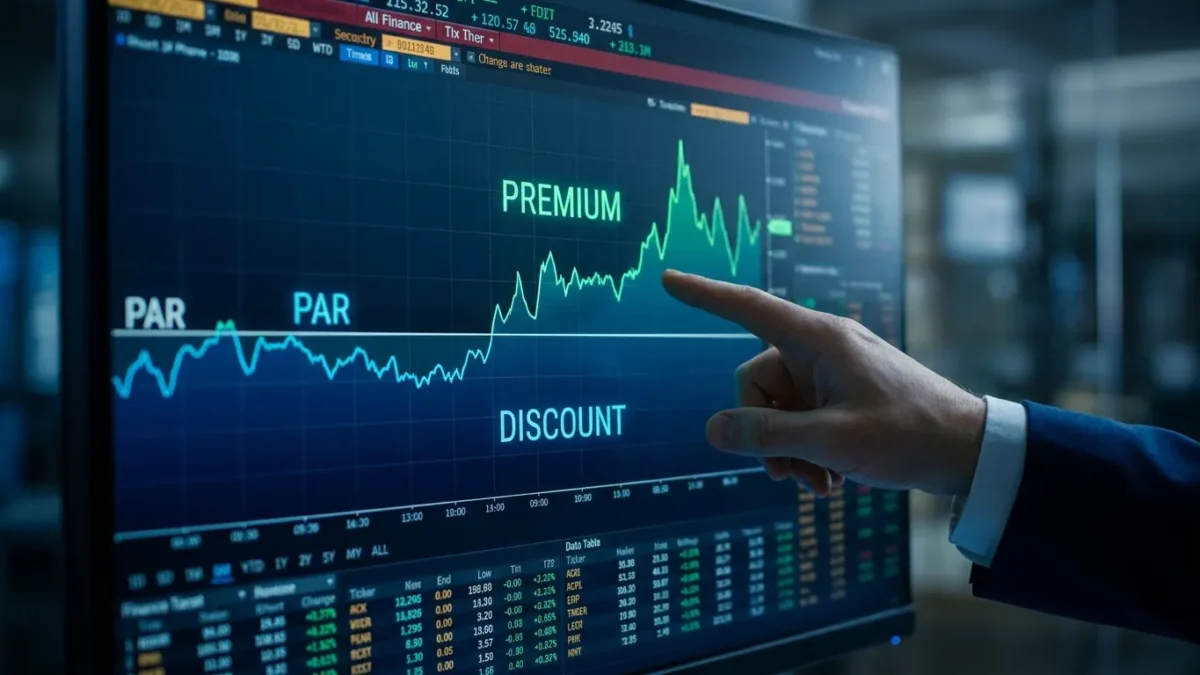
Bonds trade at a premium or discount primarily because secondary market prices adjust to align an existing bond’s fixed coupon rate with current market interest rates. When prevailing interest rates shift across the broader economy, the fixed dollar payments on existing debt remain unchanged. Secondary market participants bid prices up or down so that the yield matches the return available on newly issued securities.
At BoringMagazine.Co, we explain financial mechanics in clear terms. You can also explore our Finance guides to learn about related credit and debt topics. Understanding why bonds trade above or below face value helps investors evaluate risk and price fluctuations.
How Market Interest Rates Drive Bond Prices
A bond represents a loan from an investor to an issuer, such as a corporation or government agency. Fixed-income bonds come with three core specifications:
- Par Value: The nominal face value, standardly $1,000 for corporate and municipal bonds. This principal is returned at maturity.
- Coupon Rate: The fixed annual interest rate paid by the issuer. A 5% coupon pays $50 per year on a $1,000 bond.
- Maturity Date: The date on which the issuer repays the par value and retires the bond.
After issuance, bonds trade on the secondary market where economic conditions shift constantly. When benchmark interest rates rise or fall, an existing fixed-rate bond cannot alter its coupon payments. Its price must move instead.
This creates an inverse relationship between market rates and bond prices. When interest rates rise, existing bonds paying lower coupons drop in price until their yield matches new issues. When interest rates fall, existing bonds with higher coupons rise in price until their yield matches the lower prevailing rates.
The Mechanics of Premium vs. Discount Bonds
Secondary market pricing divides bonds into three states relative to par value:
- Trading at Par: A bond trades at par when its market price equals its face value. This occurs when the coupon rate equals prevailing market rates for similar debt.
- Trading at a Premium: A bond trades at a premium when its market price exceeds face value. This occurs when its coupon rate is higher than current market yields. Buyers pay more than $1,000 to secure those higher periodic cash payments.
- Trading at a Discount: A bond trades at a discount when its market price falls below face value. This occurs when its coupon rate is lower than current market yields. Sellers accept less than $1,000 to attract buyers who could otherwise get higher yields on new debt.
These price adjustments ensure that buyers earn a comparable Yield to Maturity (YTM). Yield to maturity balances recurring coupon income with the capital gain or loss realized at maturity.
Step-by-Step Numerical Examples
Consider a 10-year bond with a $1,000 par value and a 5% coupon, paying $50 annually.
Scenario A: Market Rates Fall to 4%
If prevailing rates fall to 4%, new bonds pay $40 annually per $1,000. Because the older bond pays $50, investors bid its price up to approximately $1,067. The buyer receives $50 each year, but experiences a $67 capital loss when the bond matures at $1,000. That capital loss offsets the higher coupons, reducing net yield to 4%.
Scenario B: Market Rates Rise to 6%
If prevailing rates rise to 6%, new bonds offer $60 per year. Buyers will not pay $1,000 for a bond paying $50. The price drops to approximately $938. The buyer collects $50 annually plus a $62 capital gain at maturity, creating an effective 6% yield.
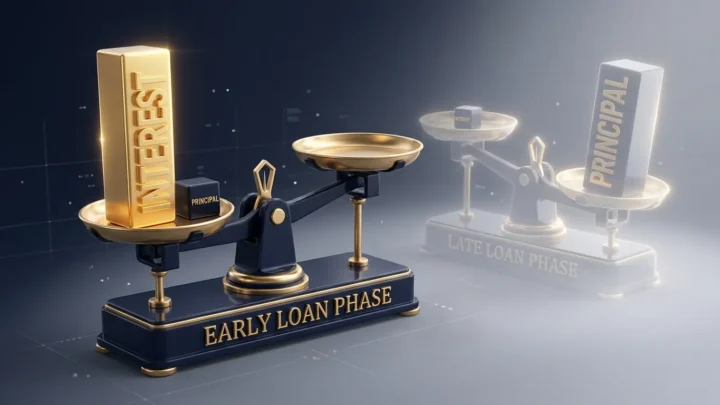
Tracking cash flows over time is common across credit products. While mortgage borrowers examine why loan payments consist mostly of interest early in an amortization schedule, bondholders watch how price changes offset fixed interest coupons.
Other Factors That Shift Bond Prices
Prevailing interest rates are the main pricing factor, but other variables also cause bonds to trade away from par:
- Credit Rating Changes: If an issuer suffers financial distress, rating agencies downgrade its debt. Investors demand higher yields to compensate for default risk, pushing the price down into discount territory.
- Duration and Maturity: Long-term bonds have greater duration, meaning their prices swing more dramatically in response to interest rate changes than short-term bonds.
- Call Provisions: If interest rates decline, issuers often call back bonds to refinance at lower rates. This possibility caps the premium investors will pay.
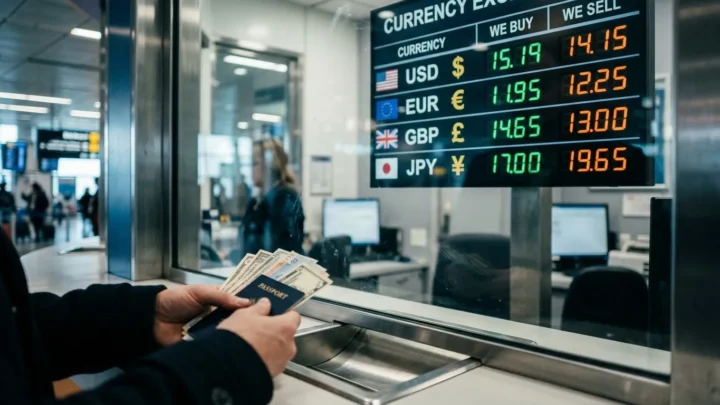
- Market Liquidity: Infrequently traded bonds carry wider dealer spreads. Just as dealers price foreign currency exchange spreads to cover risk, bond brokers discount illiquid bonds.
Investors can review government bond data through TreasuryDirect or check corporate disclosures via the U.S. Securities and Exchange Commission.
Common Misconceptions About Bond Prices
Fixed-income markets often confuse newcomers. Here are three common misconceptions:
- Myth 1: Discount bonds are always bargains. A bond priced at $920 is not automatically a deal. Its lower price simply compensates for below-market coupon payments. Both discount and premium bonds price to provide a fair market yield based on their risk profile.
- Myth 2: Falling bond prices mean permanent losses. A price drop represents an unrealized loss only if you sell before maturity. If you hold the bond until maturity and the issuer stays solvent, you receive the full $1,000 par value.
- Myth 3: Fixed coupons adjust over time. Fixed-income coupon payments stay constant. Market price moves because the coupon cannot change.
This material provides general financial education, not individual investment advice. Debt instruments carry specific credit, tax, and liquidity risks. Consult a licensed financial advisor before buying or selling secondary market securities.
FAQ
Why does a bond price drop when interest rates rise?
A bond price drops when interest rates rise because its fixed coupon payments become less attractive compared to new bonds offering higher yields. Investors discount the bond’s price so its total return matches prevailing market rates.
What happens to a premium bond when it reaches maturity?
A premium bond returns its exact par value at maturity, meaning its market price steadily declines toward face value as the maturity date nears. This predictable convergence is called premium amortization.
Can a bond trade at both a premium and a discount over its life?
Yes, a single bond can trade at both a premium and a discount over its life as macroeconomic interest rates cycle up and down. A 30-year bond might trade at a premium during low-rate periods and fall to a discount when benchmark rates climb.