Light affects melatonin production by striking specialized retinal cells in the eyes, which send electrical signals to the brain to halt the synthesis of melatonin until darkness returns. At BoringMagazine.Co, we examine the underlying biology of human health. Understanding this pathway explains why morning daylight promotes daytime alertness and why late-night screen exposure disrupts sleep timing.
Melatonin is often described as a sleep hormone, yet its true biological role is to serve as a chemical messenger for darkness. Produced by the pineal gland, melatonin levels rise after dusk, peak in the middle of the night, and fall near dawn. This daily cycle depends directly on environmental light detected through the eyes.
When light enters the eye, it does more than form visual images. It activates a neural circuit connecting the retina to the central circadian pacemaker in the brain. In our Health guides, we explain how these physiological systems operate without medical jargon.
The Retinal Pathway That Detects Light
Human vision relies on rods and cones to distinguish shapes, details, and colors. Circadian regulation depends on a distinct set of cells known as intrinsically photosensitive retinal ganglion cells, or ipRGCs. These cells make up a small fraction of all retinal ganglion cells.
Unlike standard rods and cones, ipRGCs contain a photopigment called melanopsin. Melanopsin responds directly to photons without assistance from neighboring photoreceptors. It is sensitive to short-wavelength blue light, which peaks near 480 nanometers, matching the blue hue of the open morning sky.
When blue photons hit melanopsin, ipRGCs fire action potentials down their axons. Instead of traveling to the visual cortex where the brain builds pictures, these axons form the retinohypothalamic tract. This specialized neural highway carries light signals straight into the anterior hypothalamus.
How the Suprachiasmatic Nucleus Relays the Signal
The retinohypothalamic tract terminates at the suprachiasmatic nucleus, or SCN. Located just above the optic chiasm, the SCN contains roughly twenty thousand neurons that function as the master biological clock.
When daytime light signals reach the SCN, its neurons release glutamate to register daytime. The active SCN then sends inhibitory signals down an indirect sympathetic pathway to suppress the pineal gland. This multi-step pathway includes several stages:
- Paraventricular nucleus: The SCN sends inhibitory signals to the paraventricular nucleus of the hypothalamus.
- Upper spinal cord: Signals travel down through the brainstem to the upper thoracic spinal cord.
- Superior cervical ganglion: Fibers ascend to the superior cervical ganglion in the neck.
- Pineal gland: Sympathetic nerves reach the pineal gland, controlling the release of norepinephrine.
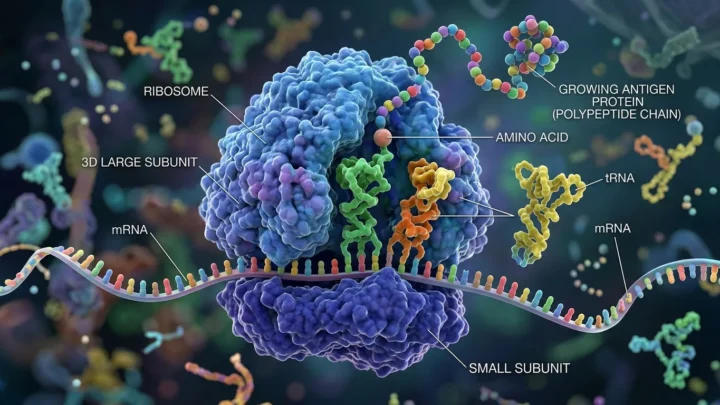
During daylight, the SCN suppresses this sympathetic circuit. Pineal cells receive minimal norepinephrine, leaving an enzyme called arylalkylamine N-acetyltransferase, or AANAT, inactive. Because AANAT converts serotonin into melatonin, production stops. Just as cells depend on exact chemical instructions, as shown in our guide on how cellular ribosomes translate mRNA, the pineal gland requires this specific enzyme to build melatonin.
When darkness arrives, retinal signaling drops. The SCN releases its inhibitory grip, allowing the superior cervical ganglion to release norepinephrine onto pineal cells. This activates AANAT, causing a surge in melatonin synthesis.
Key Differences in Light Wavelength and Timing
The biological impact of light on melatonin depends on wavelength, intensity, and timing.
Wavelength dictates how strongly melanopsin reacts. Blue light between 460 and 490 nanometers causes the steepest drop in melatonin production. Warmer tones like red or amber light have longer wavelengths that barely register with melanopsin. While bright red light can still keep you awake by stimulating attention, it does not trigger the biochemical pathway that shuts down melatonin synthesis.
Intensity is measured in lux. Standard indoor lamps provide 100 to 300 lux, which can suppress melatonin in dim environments. Natural morning sunlight reaches 10,000 to 100,000 lux, providing an unmistakable signal that resets circadian timing.
Timing determines how the internal clock adjusts. Bright light early in the morning advances your circadian rhythm, prompting earlier evening melatonin release. Bright light late in the evening delays the clock, pushing back melatonin release and making sleep onset difficult.
Real-World Examples of Light Exposure on Melatonin Cycles
The relationship between retinal light and melatonin production is visible across several common routines.
Consider an office employee who takes a twenty-minute morning walk outside. The intense natural light enters the eyes and promptly shuts down any lingering melatonin synthesis. This clears grogginess and anchors the SCN clock. As a result, the pineal gland begins its next melatonin cycle roughly fourteen hours later.
Contrast that scenario with someone using a bright smartphone in bed at 11:00 PM. The screen sits inches from the eyes, delivering concentrated blue light to ipRGCs. The SCN interprets this input as extended daylight, halting melatonin release and delaying sleepiness well past midnight.
Shift workers face an even harder conflict. Nurses and factory workers under bright lights at 3:00 AM experience suppressed melatonin when their bodies expect peak levels. When they head home into morning sunlight, their eyes receive another suppressive signal, making daytime rest fragmented and light.
Common Misconceptions About Light and Melatonin
Misconceptions regarding light and sleep hormones often lead people to adopt ineffective habits.
One widespread myth is that closed eyelids block all incoming light. Human eyelids are thin tissue layers that transmit a portion of ambient light. Sleeping near illuminated streetlights or bright electronics can stimulate retinal cells during the night, reducing peak melatonin release.
Another error is assuming that blue-blocking glasses allow unlimited evening screen use. Tinted lenses reduce short wavelengths, but bright light of any color stimulates visual pathways and promotes cognitive arousal. Wearing special glasses in a fully lit room does not simulate darkness for the brain.
Many people also assume melatonin acts like a sedative drug. Melatonin does not knock out the nervous system. Instead, it signals biological night to body tissues. Studies archived by the National Institutes of Health confirm that even brief light exposure during normal dark hours can rapidly reduce circulating melatonin.
FAQ
Does blue light completely stop melatonin production?
Blue light does not permanently stop melatonin production, but it suppresses the hormone more aggressively than other wavelengths. When blue wavelengths strike melanopsin in the retina, the brain receives an immediate signal to suspend melatonin synthesis until light levels drop.
Can taking melatonin supplements replace healthy light habits?
Taking melatonin supplements cannot replace healthy light habits because environmental light synchronizes the master circadian clock that coordinates many biological processes beyond sleepiness. While a supplement adds melatonin into the blood, it does not reset the suprachiasmatic nucleus.
When should you consult a doctor about sleep problems?
You should consult a physician or sleep specialist if severe insomnia, extreme fatigue, or erratic sleep schedules disrupt daily life despite consistent light habits. This guide provides general educational information rather than personal medical care. A healthcare provider can diagnose underlying sleep disorders and outline safe treatments.