Foley sound works in movies by having physical performers, called Foley artists, recreate everyday character sound effects on a specialized recording stage while watching the edited film in real time. On movie sets, boom microphones focus on dialogue, leaving footsteps, clothing rustle, keys, and door latches faint or lost behind room noise. Foley artists replace those missing sounds during post-production by performing actions in sync with the picture. At BoringMagazine.Co, we explore how film crews craft convincing cinematic worlds. As explained across our Entertainment guides, modern workflows separate visual production from final audio assembly to give sound editors full control over the mix.
How Foley Stages Function During Post-Production
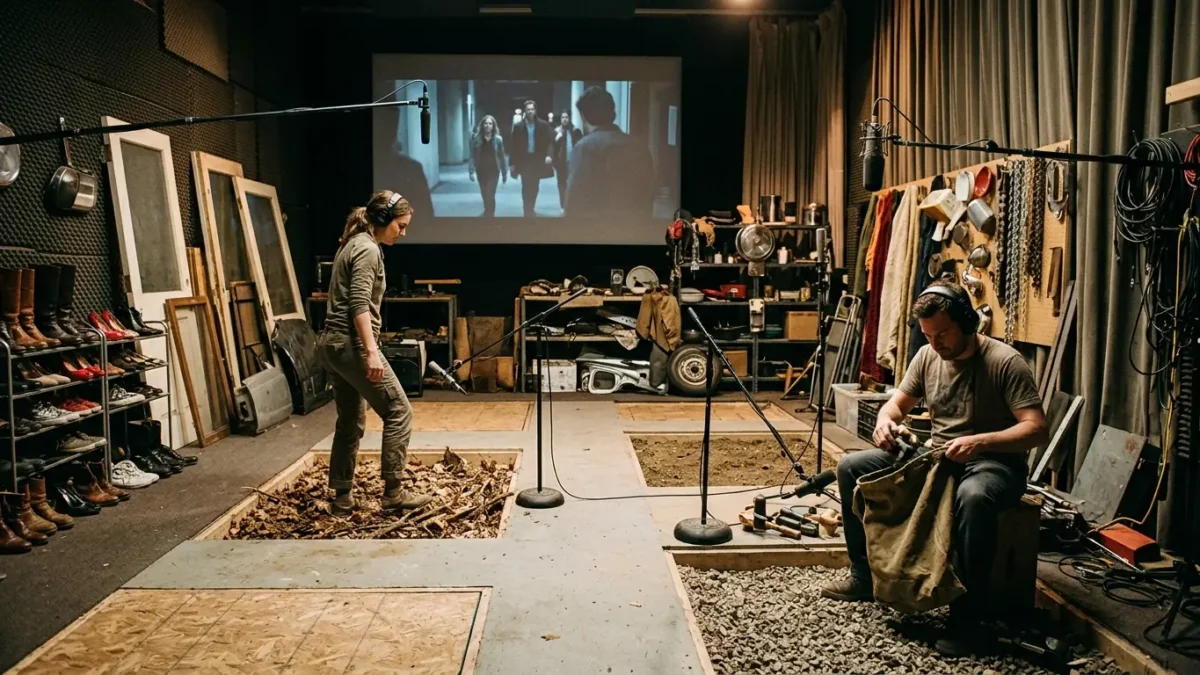
Foley recording happens on an acoustically treated sound stage that blocks exterior noise. The room features a projection screen displaying the edited scene with timecode. In an adjacent control room, a Foley mixer sets microphone levels, manages preamps, and records takes into a digital workstation.
The Foley artist watches the actor on screen and mirrors their physical rhythms. If a character walks across a room and sets down a glass, the artist executes those exact motions live on stage. The mixer captures the take and reviews sync to confirm every sound lands on the right frame. This process also supports international distribution. When foreign studios replace English dialogue with dubbed tracks, Foley tracks preserve all physical sounds without keeping original set audio.
The Three Main Categories: Footsteps, Cloth, and Specifics
Foley artists divide their work into three standard tracks: footsteps, cloth movement, and specifics.
Footsteps require physical endurance and rhythm. Artists use collections of footwear, from sneakers to hard-soled shoes and work boots. They study an actor’s gait, weight distribution, and mood. A nervous character pacing across tile requires a faster cadence than an exhausted worker trudging home.
Cloth movement, often called moves or rustle, captures garments rubbing together as actors turn, sit, run, or hug. Artists hold fabrics like denim, leather, cotton, or wool near a microphone and manipulate them in time with the on-screen action.
Specifics cover all prop interactions not classified under footsteps or clothing. This group includes setting down cups, opening briefcases, handling cutlery, jingling keys, and opening doors. Recording these actions on separate tracks allows re-recording mixers to balance volume levels during the final mix.
Inside the Foley Stage: Multi-Surface Pits and Prop Collections
The floor of a Foley stage features sunken rectangular pits filled with different walking surfaces. Standard pits contain concrete, hardwood boards, gravel, flagstone, asphalt, dry dirt, sand, and shallow water basins.
Walking across these pits allows the artist to match the terrain on camera. If a character steps from a wood floor onto a stone porch and across gravel, the Foley artist steps across matching pit surfaces in continuous sequence. Hollow subfloors beneath wood pits replicate resonant home floors, while dense stone surfaces simulate commercial corridors.
The stage prop room holds an inventory gathered from thrift stores and salvage yards. You will find old rotary phones, car door latches, rusty hinges, silverware, and broken clocks. The acoustic value of a prop depends on how it registers through a microphone rather than its visual appearance.
Audio-to-Picture Timing and Microphone Placement
Precise synchronization requires physical coordination and visual anticipation. Experienced Foley artists watch an actor’s shoulders and torso rather than reacting only to foot or hand movements. Anticipating the motion helps the artist strike a prop or take a step on the exact frame of contact.
Microphone distance establishes the acoustic perspective of each scene. In a wide shot, the Foley mixer positions the microphone several feet away to capture natural room reflections. When the camera cuts to a close-up of fingers turning a key, the microphone moves within inches to record a dry, intimate signal.
Engineers use directional shotgun microphones or condenser microphones to balance direct contact sound with room reflections. Just as directors rely on cinematic aspect ratios and frame compositions to guide the viewer’s eye, sound teams balance distance and volume to guide the listener’s focus.
Creative Prop Substitutions Used in Classic Film Scenes
Foley artists often avoid using the real objects seen on screen because genuine objects can sound flat through a microphone. Artists use creative substitutions to generate textures that match audience expectations.
Food is one of the most common materials used on Foley stages. Snapping celery or breaking raw pasta produces crisp sounds for breaking bones. Squeezing wet cantaloupes or damp rags generates impact sounds for fight scenes.
Other proven substitutions include:
- Flapping leather work gloves near the microphone to create bird wings in flight.
- Squeezing leather pouches filled with cornstarch to reproduce footsteps in dry snow.
- Twisting cassette tape ribbons to simulate the crackle of a campfire.
- Dragging metal rakes across concrete to produce harsh mechanical squeals.
Sound professionals earn recognition for these craft achievements through groups like the Motion Picture Sound Editors. Once Foley passes are edited into clean stems, production teams document all sound cues alongside music cue sheets and broadcast audio logs to complete delivery requirements.
Common Misconceptions About Movie Foley Audio
A frequent misconception is that Foley artists create every sound effect in a movie. Foley artists focus specifically on human-scale character interactions, such as footsteps, clothing, and handheld props. Large events like car crashes, explosions, and monster roars belong to sound designers, who build effects using synthesized audio and field recordings.
Another misconception is that digital sound libraries have made physical Foley stages obsolete. While editors have access to vast digital libraries, static sound files lack human flexibility. Actors change pace, shuffle, or hesitate based on emotion. A Foley artist can perform those subtle timing shifts in minutes, producing a more natural track than an editor assembling dozens of separate audio files manually.
FAQ
Why is it called Foley sound?
Foley sound is named after Jack Foley, an early sound technician at Universal Studios who developed techniques for performing live audio effects in sync with projected motion pictures in the late 1920s. Foley recognized that recording footsteps and props live during post-production produced cleaner audio than capturing them on noisy filming sets.
Why do filmmakers record Foley instead of using on-set audio?
Filmmakers record Foley because set microphones focus on dialogue, leaving physical interactions faint or muffled. Recording Foley tracks in a quiet studio allows mixers to balance every movement, cloth rustle, and step without bringing in set noise.
How does Foley differ from sound effects libraries?
Foley differs from sound effects libraries because Foley tracks are performed live to match the specific rhythm, speed, and emotional tone of an actor’s performance. Pre-recorded library clips work well for static background sounds, but they lack the customized timing of a live studio performance.