When reviewing AP vs IB credit acceptance, college registrars award credit for Advanced Placement on an individual course-by-course basis, whereas they evaluate International Baccalaureate through either single Higher Level subjects or comprehensive diploma recognition policies.
Both programs allow ambitious high school students to tackle university-level material and demonstrate academic rigor. However, the mechanism by which higher education institutions grant academic credit differs substantially between the two systems. A high score on an Advanced Placement test grants credit for a specific introductory course at many institutions, while the International Baccalaureate curriculum offers two separate avenues: standard credit by exam for specific courses or broad general education waivers for earning the complete diploma. At BoringMagazine.Co, we examine these structural distinctions so students and families can make informed choices about their high school academic paths. If you want to understand how secondary coursework shapes postsecondary degree progress, explore our Education guides for detailed analyses of academic credentials.
How Advanced Placement Scoring and Credits Work
The Advanced Placement program, managed by the College Board, operates on a modular subject model. High school students can take one AP course or ten, depending on their interests and school offerings. Each course culminates in a standardized exam administered in May, scored on a scale from 1 to 5:
- 5: Extremely well qualified
- 4: Well qualified
- 3: Qualified
- 2: Possibly qualified
- 1: No recommendation
Universities establish their own score thresholds for granting college credit. A score of 3 represents passing work, but many selective universities require a 4 or 5 before granting units toward graduation. Because AP operates on a course-by-course basis, every exam result stands completely independent of the others. A student who scores a 5 in AP English Literature and a 2 in AP Chemistry will receive full credit consideration for literature without penalty from the low chemistry score.
Institutions usually award credit in one of two ways: course equivalence or general elective hours. Course equivalence means the exam replaces a specific required class, such as awarding credit for English 101 or Calculus 1. Elective credit adds hours toward the total units needed for graduation without satisfying specific major or general education requirements.
How International Baccalaureate Scoring and Credits Work
The International Baccalaureate Diploma Programme, administered by the International Baccalaureate Organization, takes an integrated, holistic approach to secondary education. Unlike the modular nature of AP, the full IB Diploma requires students to complete courses across six academic subject groups alongside three core components: the Theory of Knowledge class, the Extended Essay, and Creativity, Activity, Service projects.
IB courses come in two formats: Standard Level (SL) and Higher Level (HL). Standard Level courses involve 150 teaching hours, while Higher Level courses demand 240 teaching hours and cover topics in greater depth. Exams use a numerical grading scale from 1 to 7, where 4 reflects passing performance:
- 7: Excellent performance
- 6: Very good performance
- 5: Good performance
- 4: Satisfactory performance
- 3: Mediocre performance
- 2: Poor performance
- 1: Very poor performance
Credit acceptance for IB courses depends heavily on exam level. Most colleges in the United States award subject credit only for Higher Level exams with scores of 5, 6, or 7. Standard Level exams rarely qualify for credit at American universities, with only a few state systems granting elective units for exceptional SL scores. However, students who complete the full IB Diploma with strong composite marks often qualify for comprehensive credit packages that exceed individual exam awards.
Key Differences in College Credit Acceptance
The central division between the two programs lies in modularity versus comprehensive curriculum evaluation. Advanced Placement provides predictable flexibility. A student can choose single subjects that align with their strengths, and each exam carries the exact same evaluation weight at a college registrar desk regardless of how many other exams the student took.
International Baccalaureate credit policies operate on two separate tracks. Students taking individual IB courses without seeking the diploma follow a path similar to AP, but their credit potential is cut in half because universities generally ignore Standard Level classes. In contrast, students who finish the full diploma program often secure accelerated degree standing. Many universities publish distinct credit charts for diploma holders, granting automatic sophomore standing or waiving entire blocks of freshman general education coursework.
This dynamic also differs from direct college coursework options such as dual enrollment in high school. Dual enrollment courses generate real grades on official college transcripts, whereas AP and IB results produce credit by examination without influencing the college grade point average.
Real Campus Examples: State Systems vs Private Universities
Public state university systems and private universities approach exam credits with contrasting philosophies. Public universities frequently operate under legislative directives designed to lower tuition burdens and shorten time to graduation for in-state residents.
In Texas, state law mandates that public universities award credit to entering freshmen who score a 3 or higher on AP exams. The same statute requires public institutions to grant at least 24 semester credit hours to students who complete the IB Diploma with scores of 4 or higher on each subject exam. The State University of New York and University of California systems similarly publish transparent statewide conversion tables that guarantee credit for scores meeting set thresholds.
Private universities maintain complete institutional autonomy. Highly selective private colleges often restrict credit awards. Some elite institutions refuse to grant credit for AP scores below 5, while others reject credit awards entirely, offering course placement instead. Course placement allows a student to skip introductory classes and enroll in advanced courses right away, but it does not reduce the total credit hours required to earn a bachelor degree.
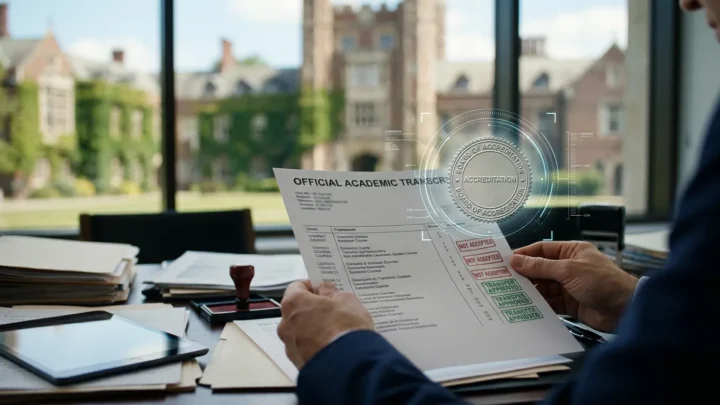
These institutional differences mirror broader variations across higher education, comparable to how college accreditation and credit transfers depend on institutional policy and state standards.
Common Credit Mistakes and Misconceptions
Families frequently make faulty assumptions when planning high school schedules around anticipated college credits. Avoiding these common traps helps ensure that student effort translates into tangible degree progress.
- Assuming passing scores always satisfy major requirements: Scoring a 3 or 4 on AP Biology might satisfy a university natural science general education requirement for a history major, but the same university biology department may require pre-med students to take the on-campus introductory series.
- Overlooking institutional credit maximums: Most colleges cap the total number of credits a student can bring from pre-college examinations. Even if a student passes twelve AP exams, the university may cap total examination credits at 30 semester hours.
- Treating Standard Level IB as equivalent to AP: Students sometimes assume that because both are high school courses with rigorous exams, colleges treat them equally. In reality, most American universities give zero college credit for IB Standard Level classes.
- Neglecting departmental credit guides: Credit acceptance policies are set by individual academic departments rather than general admissions offices. A score that yields credit in the history department might fail to satisfy standards in the mathematics department at the exact same campus.
Related on BoringMagazine.Co: How the Student Aid Index Is Calculated on the FAFSA.
FAQ
Does college credit acceptance favor AP or IB?
College credit acceptance favors AP for individual course flexibility, whereas IB yields greater benefits when a student earns the full diploma at an institution with block transfer policies. Students taking standalone courses usually receive more usable credit from AP because American colleges rarely award credit for IB Standard Level exams.
Do colleges accept IB Standard Level exams for course credit?
Most United States colleges do not accept IB Standard Level exams for course credit, restricting awards to Higher Level exams with scores of 5 or above. Only a limited number of public universities offer elective credits for Standard Level scores, making Higher Level courses the primary source of IB college credit.
Can AP and IB credits reduce college tuition costs?
AP and IB credits can reduce college tuition costs if the accepted credits allow a student to graduate early or skip full semesters of coursework. When exams only fulfill general elective units rather than mandatory degree requirements, students may still need the standard four years of tuition to complete their majors. Because tuition structures and billing rules vary across campuses, students should consult an academic advisor or financial aid officer to confirm how test credits influence their degree timeline.