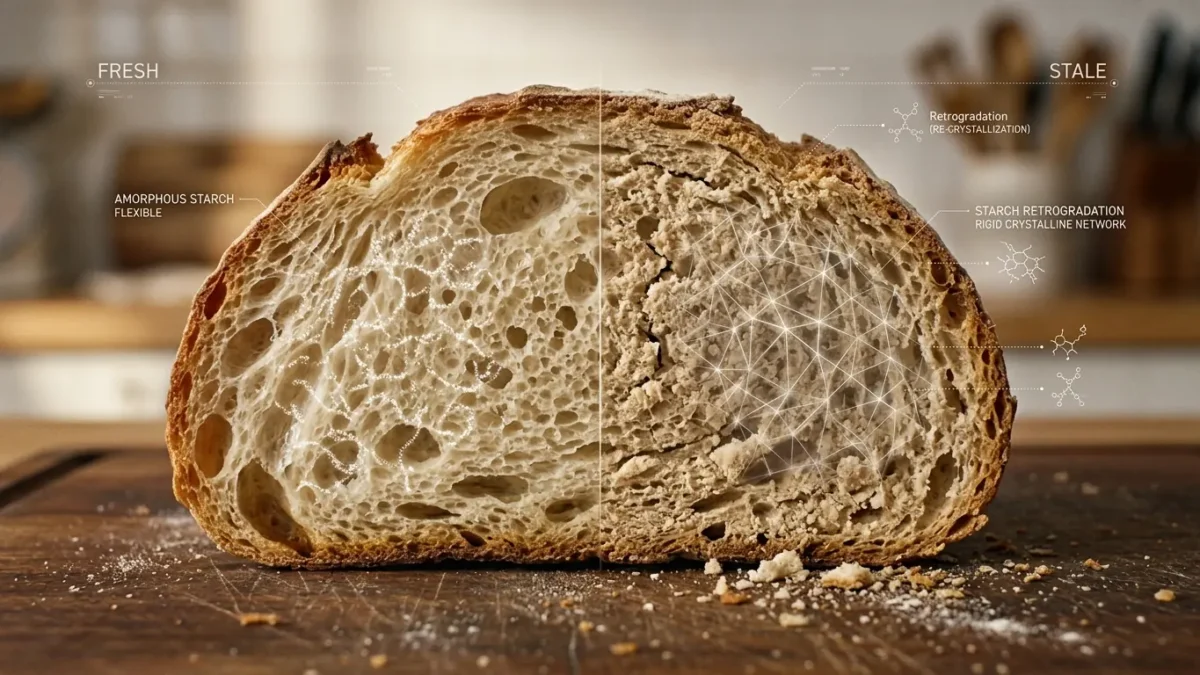
Starch retrogradation in bread and pasta is the chemical process where cooked, gelatinized starch molecules realign into an ordered crystalline structure as they cool, causing soft baked goods and noodles to turn firm, dry, and stale. When you bake bread or boil pasta, starch granules swell with water to create tender textures. As those starches cool, the molecular chains pack tightly against one another again. At BoringMagazine.Co, we cover everyday food chemistry to explain how simple temperature changes alter kitchen staples.
The Chemistry of Starch: Gelatinization Before Retrogradation
To understand why cooked starch turns stale, you must first look at what happens during cooking. Raw flour and semolina contain microscopic starch granules composed of two glucose polymers: amylose and amylopectin. Amylose forms straight molecular chains, while amylopectin forms large branched trees.
In raw flour, these polymers are insoluble and tightly packed. Cooking disrupts this order. When you bake dough or boil noodles, heat breaks the hydrogen bonds between polymers, allowing water to enter and swell the granules.
This swelling is called starch gelatinization. Above 140 degrees Fahrenheit (60 degrees Celsius), the granules burst and release amylose into the water, forming an amorphous gel network. This gel gives fresh bread its soft crumb and cooked pasta its tender chew. To explore related kitchen science, read our Food guides on molecular changes during cooking.
How Retrogradation Works Step by Step
Retrogradation starts as soon as cooked starch cools. Without heat, the starch molecules lose kinetic energy and begin forming new hydrogen bonds with neighboring chains. This process occurs in four stages:
- Cooling and molecular slowing: Heat dissipates and the flexible glucose polymers slow down, drifting closer together.
- Amylose realignment: Linear amylose chains line up quickly side by side, creating a firm network within hours.
- Water expulsion: Tightening polymer chains squeeze water out of the gel network, an effect called syneresis.
- Amylopectin recrystallization: Over several days, branched amylopectin chains slowly interlock into rigid crystalline structures.
This shift turns a hydrated gel into a firm solid. Even when sealed in plastic, the food feels dry because water is no longer held uniformly by the starch network.
Amylose vs. Amylopectin: Two Speeds of Starch Hardening
The rate of retrogradation depends on the ratio of amylose to amylopectin. Amylose has a linear shape that aligns rapidly with little resistance. This rapid alignment occurs within hours of cooling, giving cold pasta its initial firmness and pudding its skin.
Amylopectin has thousands of bushy branches that slow down alignment. It takes days or weeks for these branches to find matching partners and crystallize. This slow recrystallization causes long-term staling in bread crumb.
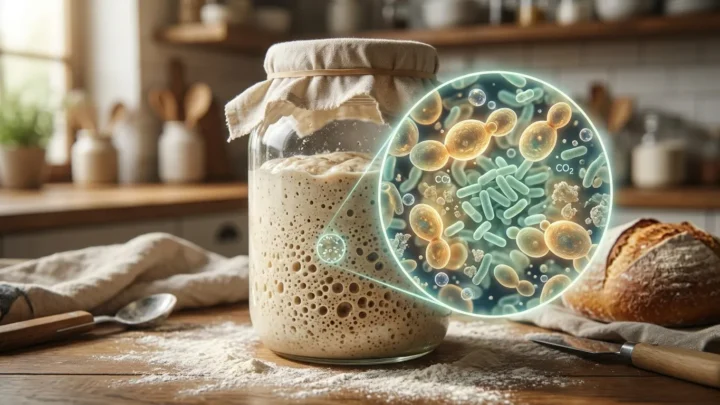
Fermented breads resist this hardening longer. The natural acids created during sourdough starter fermentation partially hydrolyze starches and alter gluten, slowing down the rate at which amylopectin crystallizes.
Real Kitchen Examples: Stale Bread vs. Cold Pasta
Starch retrogradation produces different textures depending on moisture levels and cooking methods.
In bread, retrogradation happens in a low-moisture system. As amylopectin forms crystals, water leaves the starch and moves toward gluten proteins or the crust. The crumb loses elasticity, becoming dry and crumbly even though total moisture remains inside the loaf.
In pasta, retrogradation occurs after boiling in excess water. When cooked pasta chills in the refrigerator, amylose chains lock into a firm structure known as Type 3 resistant starch. Because digestive enzymes cannot easily break down these crystalline structures, cold pasta acts like dietary fiber and produces a slower rise in blood sugar than hot pasta.
Similar changes happen in other foods. Chilled rice turns hard, cooled oatmeal turns stiff, and refrigerated gravies weep liquid as starches contract.
Common Misconceptions About Staling and Food Storage
Many home cooks adopt storage habits that unintentionally speed up starch crystallization.
A frequent misconception is that staling is merely water loss. While an uncovered loaf will dry out, bread sealed in plastic stales at the exact same speed. The crumb turns firm due to internal starch rearrangement, not evaporation.
Another common mistake is storing bread in the refrigerator. Starch retrogradation peaks between 32 and 45 degrees Fahrenheit (0 to 7 degrees Celsius). In this range, molecules move slowly enough to form bonds, but fast enough to find partners quickly. Bread kept in the refrigerator stales up to six times faster than bread kept on the counter.
To keep bread fresh, store it at room temperature in a bread box for up to three days. For longer storage, freeze sliced bread. Freezing drops the loaf below the glass transition point, stopping molecular movement and preventing crystal formation.
Why Reheating and Toasting Temporarily Resets Softness
Because hydrogen bonds in retrograded amylopectin are relatively weak, retrogradation is thermally reversible. Heating stale starch above 140 degrees Fahrenheit (60 degrees Celsius) melts those crystals.
Warming stale bread in an oven or microwave melts recrystallized amylopectin back into a soft gel. Water returns to the starch matrix, restoring softness to the crumb. Similarly, heating cold pasta melts retrograded starches, returning noodles to a tender state.
Toasting adds crisp texture and rich flavors through surface browning. To see how dry heat creates deep flavor, read our guide on the chemical difference between the Maillard reaction and caramelization.
This reset is only temporary. When reheated starch cools down, retrogradation resumes immediately. The second round of staling often happens faster because surviving crystal fragments serve as templates for new crystal growth.
FAQ
Does retrograded starch lower available calories?
Retrograded starch slightly reduces available calories because its tight crystalline structure resists breakdown by human digestive enzymes. When cooked starch cools, part of it converts into Type 3 resistant starch, which passes undigested into the large intestine. Gut bacteria ferment this starch into short-chain fatty acids, yielding fewer net calories than fully digested glucose.
Can you permanently reverse starch retrogradation?
You cannot permanently reverse starch retrogradation because starch polymers naturally return to a crystalline state whenever they cool. Reheating melts the crystal structures and temporarily softens food, but cooling restarts the crystallization process. Repeated reheating also drives off moisture, eventually making the food tough and dry.
Why does refrigerated bread stale faster than counter bread?
Refrigerated bread stales faster than room temperature bread because temperatures between 32 and 45 degrees Fahrenheit provide ideal conditions for amylopectin crystallization. At room temperature, higher thermal energy slows crystal formation. In the freezer, ice formation halts molecular motion completely. The refrigerator sits at the exact temperature where starch recrystallizes fastest.