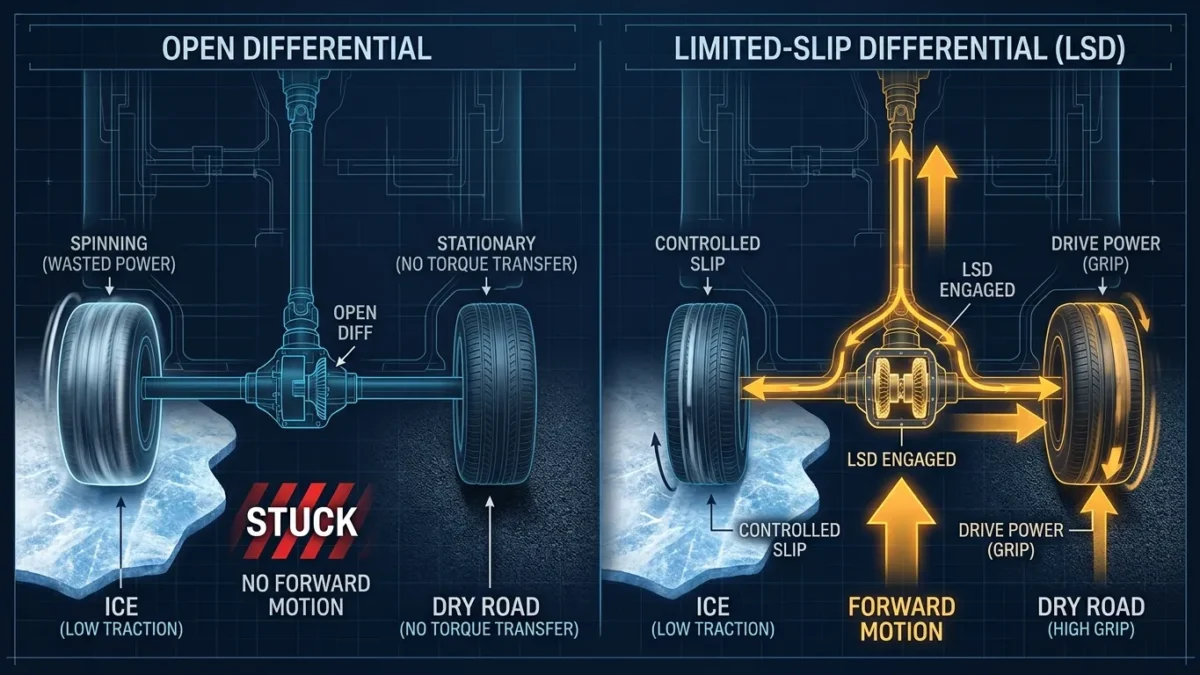
A limited-slip differential works by mechanically restricting the speed difference between two drive wheels on an axle, transferring usable torque to the tire with grip when the opposite tire begins to slip. While an open differential always splits torque evenly between both sides, a limited-slip unit prevents a slipping tire from wasting all available engine power. When one wheel hits ice, wet leaves, or loose dirt, internal friction clutches or angled gears clamp the axle shafts together. This mechanical engagement ensures that the tire on solid ground receives sufficient torque to move the vehicle forward. Drivers encounter this technology in performance cars, light trucks, and rear-wheel-drive vehicles where steady traction is required for stability and swift acceleration.
The Mechanical Role of an Open Differential
To grasp how a limited-slip differential functions, it helps to review a standard open differential. When a vehicle rounds a curve, the outside wheel travels along an arc of longer radius than the inside wheel. Because that outside wheel covers more distance in the same span of time, it must turn faster. An open differential permits this variation in wheel speed through an assembly of spider gears and axle side gears inside a rotating carrier.
The driveshaft pinion turns the large ring gear, which rotates the differential carrier. Inside this case, small bevel gears called spider gears mesh with side gears splined to each axle shaft. When driving in a straight line, the spider gears remain stationary on their shaft, and the entire carrier spins as one solid unit. During a turn, the spider gears rotate on their cross-pin, allowing the outer axle shaft to rotate faster than the inner shaft.
The core weakness of an open differential lies in its torque distribution rule. An open differential always splits torque in an exact 50/50 ratio. The total torque delivered to both drive wheels is limited by whichever tire has the least traction. If one tire rests on wet mud and requires only twenty pound-feet of torque to spin, the opposite tire on dry pavement receives only twenty pound-feet. The car sits immobilized while one wheel spins uselessly. At BoringMagazine.Co, we examine drivetrain mechanics so drivers can understand how mechanical grip controls vehicle motion.
How Internal Clutch Packs and Ramps Lock the Axle
A clutch-type limited-slip differential solves the open differential traction problem by placing multi-disc clutch packs and angled pressure rings inside the carrier. Behind each side gear sits a clutch pack made of alternating friction plates and steel discs. The friction plates feature external tabs that lock into the spinning carrier housing, while the steel plates feature internal splines that lock to the axle side gear.
A central spring pack sits between the side gears, applying constant preload against the clutch discs. Even during coasting or gentle cruising, this baseline spring tension provides resistance against relative speed differences between the two drive axles.
When the driver steps on the throttle, driving torque rotates the carrier and pushes the spider gear cross-pin against V-shaped ramps machined into the pressure rings. As torque climbs, the cross-pin rides up these ramp angles, forcing the pressure rings outward against the clutch packs. This axial force compresses the alternating discs together with great pressure.
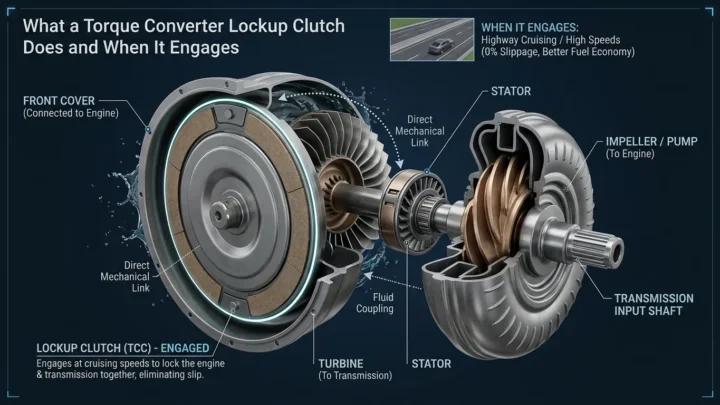
Once compressed, friction binds the axle side gears to the rotating carrier. The differential resists speed differences, routing engine power directly across the carrier case to the wheel with traction. In friction-based automotive components, such as how a torque converter lockup clutch engages friction discs to prevent slippage, mechanical clamping secures rotating parts to prevent wasted rotational energy.
Key Differences Between Open and Limited-Slip Differentials
The operational contrasts between open and limited-slip differentials define how each system manages vehicle power and wheel speed:
- Torque distribution: Open differentials always deliver equal torque to both wheels, meaning the slipping wheel dictates total driving force. Limited-slip differentials direct greater torque to the tire with superior surface grip.
- Wheel speed variance: Open differentials permit unlimited speed differences without friction. Limited-slip differentials allow moderate speed variance for cornering but restrict excessive differences under throttle load.
- Internal complexity: Open differentials use simple spider and side gear sets. Clutch-type limited-slip units add clutch packs, preload springs, and ramped pressure rings.
- Fluid requirements: Open differentials operate on standard gear oil. Clutch-type differentials require specialized friction modifier additives to keep clutch plates operating smoothly.
Real Driving Scenarios and Differential Configurations
The practical benefits of a limited-slip differential appear whenever tires experience uneven grip. For instance, when a performance car accelerates out of a sharp corner, vehicle weight shifts to the outside tire. This weight transfer leaves the inside tire lightly loaded. An open differential spins the unloaded inside tire, stalling forward acceleration. A limited-slip differential locks the axle under throttle, routing engine power to the loaded outside tire to push the car out of the turn.
Uneven road surfaces highlight a similar advantage. If one drive tire rests on ice while the other rests on dry pavement, an open differential spins the icy tire endlessly. A limited-slip unit transfers torque to the tire on pavement, allowing the vehicle to pull away smoothly.
Manufacturers calibrate mechanical clutch units by altering ramp angles, yielding three common configurations:
- 1-Way LSD: Ramps lock the clutches only under acceleration. During deceleration, the clutches disengage, allowing free differential action for easier corner turn-in.
- 1.5-Way LSD: Ramps apply full locking force under acceleration and moderate locking force under braking, stabilizing the car during aggressive deceleration.
- 2-Way LSD: Ramps apply equal locking force during both acceleration and deceleration, providing predictable rear axle lock during high-performance driving.
Drivers can review additional chassis and suspension concepts in our Automotive guides.
Common Misconceptions and Maintenance Mistakes
A common misconception is that a limited-slip differential behaves like a locked spool. A spool mechanically locks both axle shafts together permanently, forcing tires to chirp and drag during low-speed turns. A limited-slip differential allows enough slip during tight maneuvers to keep tires rolling smoothly without binding.
Another error involves choosing the wrong lubricant. Standard hypoid gear lubricants lack friction modifier additives formulated for limited-slip clutch packs. Running without friction modifier leads to clutch disc chatter, producing an audible shuddering or groaning noise during parking lot turns. Always follow factory fluid recommendations to protect clutch surfaces.
Drivers also misunderstand geared differentials, such as Torsen or helical units. Geared differentials use worm gears to generate internal friction against their casing. While they do not wear out like clutch plates, geared units need some ground resistance on both sides to function. If one wheel lifts off the pavement, a geared unit behaves like an open differential unless light brake pedal pressure is applied.
FAQ
Can a limited-slip differential cause both wheels to spin at the exact same speed?
A limited-slip differential causes both wheels to turn at near-identical speeds under heavy throttle, but it will slip when cornering forces exceed clutch friction. This design allows smooth low-speed turns while still offering dependable straight-line traction when power is applied.
Do limited-slip differentials require special gear oil?
Clutch-type limited-slip differentials require gear oil with friction modifier additives to prevent clutch plates from sticking and chattering during low-speed cornering. Geared differentials, such as helical or Torsen units, typically use standard gear lubricants without specialized additives.
What is the difference between a mechanical LSD and brake-based torque vectoring?
A mechanical limited-slip differential transfers torque across an axle through internal clutches or gears, whereas brake-based torque vectoring pulses the brake caliper on a spinning wheel. Brake-based systems mimic a limited-slip differential, but they produce extra brake heat and consume engine power instead of transferring torque mechanically.