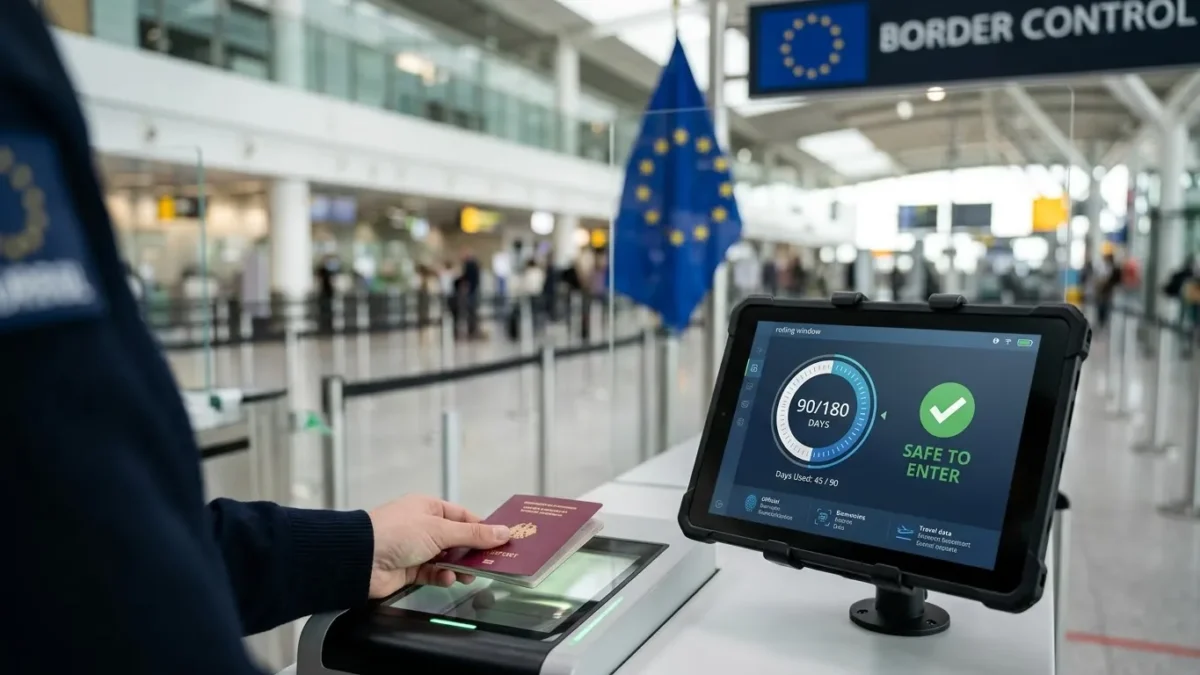
To calculate the Schengen 90/180 rule, you must count backward 180 days from every single date of your trip to confirm that your total time in the zone does not exceed 90 days. This calculation is a moving backward reference rather than a fixed calendar year or six-month block.
Non-European Union citizens traveling under a visa-free waiver or a uniform short-stay visa must follow this standard. At BoringMagazine.Co, we track how border systems process passenger data so travelers avoid administrative delays. Understanding the mechanics behind this rule prevents accidental overstays, which can trigger fines or entry bans.
The Moving 180-Day Window Explained
Many travelers assume that the Schengen allowance works on a fixed schedule, such as 90 days every six months starting on January 1. Under European Union rules, the period does not reset on a calendar schedule. The regulation relies on a dynamic rolling frame that evaluates every single day of travel individually.
When you arrive at border control, the officer or automated scanner takes that specific date as day 180 and looks backward across the previous 179 days. The system tallies all dates you spent inside any Schengen member nation during that exact span. If the sum reaches 90 days, you cannot enter or stay on that date.
As time moves forward, the entire 180-day window shifts ahead one day at a time. A travel date spent inside the zone 181 days ago drops off the calculation, freeing up a day of allowance. Because the window moves daily, you cannot calculate your stay by looking at a static calendar.
How Border Control Systems Count Days
Border authorities across Europe rely on entry and exit data to track traveler movements. When an officer scans your passport, the computer logs the date and port of entry. When checking compliance, the border software executes a backward calculation for every date you intend to be in the zone.
The official counting method treats partial days as full days. The day you land counts as day one inside the Schengen zone, even if your flight lands at 11:30 PM. The day you clear exit passport control also counts as a full day, even if your flight departs just after midnight.
Border computers aggregate your presence across all member states as one continuous territory. Time spent in France, Germany, and Spain all shares the same 90-day pool. Only time spent in non-Schengen nations pauses the count. If you are planning complex routes, check our Travel guides for advice on regional transit.
Step-by-Step Calculation for Your Trip
You can calculate your remaining days manually or by using the official calculator on the European Union portal. Performing the calculation manually requires a systematic calendar check:
- Select your target date: Choose the specific date you plan to be inside the Schengen Area.
- Count backward 180 days: Identify the date exactly 179 days prior to your target date to define the 180-day window.
- Tally your presence: Count every calendar day you were physically present in any Schengen country during that interval, including the target date.
- Check the limit: Confirm that the resulting total does not exceed 90 days.
- Repeat for each date: Repeat this check for every consecutive day of your proposed journey.
If your total reaches 90 days midway through a trip, you must leave before that day or delay your arrival. When organizing routes across Europe, booking European train seat reservations early helps ensure your transit aligns with your legal limits.
A Realistic Two-Trip Example
To see how the rolling window works in practice, imagine a traveler planning two separate trips to Italy and Germany.
Trip 1 spans February 1 through March 31. That stay equals 59 days (28 days in February and 31 days in March). The traveler then exits the Schengen zone and stays home through April and May.
The traveler plans Trip 2 to start on June 1. On June 1, the border system looks back 180 days, which reaches back to December 4 of the previous year. Within that window, the traveler has accumulated 59 days of presence. Subtracting 59 from 90 leaves 31 days of available stay.
The traveler can safely enter on June 1, but they cannot stay for another two months. If they remain through June 30, they use 30 additional days, reaching 89 total days. On July 2, the February days are still inside the 180-day window, so staying would push the total to 91 days. The traveler must leave by July 1. Setting up international travel eSIM profiles allows travelers to access calculation tools and adjust return flights if schedules shift.
Common Mistakes and Misconceptions
The most frequent error travelers make is assuming the counter resets after spending 90 days outside the zone. While a 90-day absence does clear your previous stay, shorter trips outside Europe do not reset your total. Leaving for two weeks merely pauses the tally; it does not clear past visits.
Another misconception involves confusing calendar months with 30-day blocks. The rule counts exact calendar days. A stay across July and August totals 62 days, not 60. Counting in months instead of days often leads to accidental overstays.
The 90/180-day rule applies to short-term tourist and business visits. It does not govern national long-stay visas or residence permits. Immigration regulations carry serious legal consequences, so travelers with complex itineraries should consult official consular authorities or an immigration attorney for formal legal advice.
FAQ
Does the 90-day allowance reset after leaving Europe?
No, the 90-day allowance does not reset upon leaving Europe unless you remain outside the Schengen Area for at least 90 consecutive days. The system uses a rolling window that tracks your presence across the preceding 180 days on every single date of travel. Short trips outside the zone only pause the count.
Do arrival and departure days count as full days?
Yes, arrival and departure days count as full days regardless of the time your flight lands or departs. Even if you arrive at 11:30 PM and pass passport control before midnight, that calendar date counts as one full day of your 90-day quota. Leaving just after midnight also consumes a full day.
What happens if a traveler overstays the 90-day limit?
Overstaying the 90-day limit can result in fines, administrative departure delays, or entry bans across the Schengen Area. Border authorities record entry and exit timestamps in immigration databases, and automated gates detect overstays immediately. Penalties vary by member state, but violations remain on your immigration record.