The offside rule in soccer works by penalizing an attacking player who is closer to the opponent goal line than both the ball and the second-to-last opponent at the exact moment the ball is played to them, provided they become actively involved in play. This foundational standard stops teams from positioning forwards permanently near the goal mouth to cherry-pick long passes. At BoringMagazine.Co, we examine competition rulebooks across our Sports guides to explain how officials evaluate rapid decisions on the field. Understanding Law 11 requires tracking player positioning, release timing, active interference, and modern camera calibration.
How the Second-to-Last Defender Establishes the Line
Many spectators assume that the final outfield defender sets the boundary for offside, but Law 11 specifically designates the second-to-last opponent. In ordinary situations, the goalkeeper is the furthest defending player. That leaves the deepest outfield defender as the second-to-last opponent, creating the offside boundary across the field.
If the goalkeeper charges out to contest a ball, the reference points shift. An outfield defender standing near the goal line becomes the last opponent. In that scenario, the goalkeeper or another defender standing second-closest to the endline marks the offside boundary.
An attacker stands in an offside position when meeting three conditions:
- They are in the opponents’ half of the pitch, past the halfway line.
- They are closer to the opponents’ goal line than the ball.
- They are closer to the opponents’ goal line than the second-to-last opponent.
Standing in an offside position is not an infraction on its own. Play stops only when an attacker in that location becomes actively involved.
Ball Release Timing and Playable Body Parts
Offside position is judged at the first point of contact when a teammate plays or touches the ball. Officials do not judge offside when the ball arrives at the receiving player. If an attacker starts in an onside position when a teammate strikes a long pass, that attacker can outrun defenders while the ball travels through the air without committing an infraction.
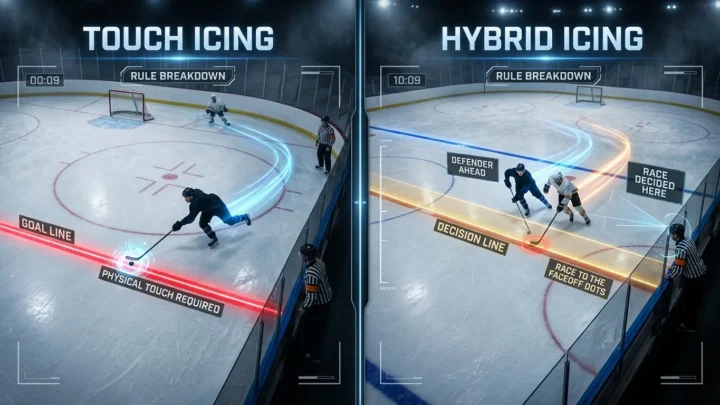
Judgments consider only body parts that can legally score a goal: the head, torso, upper legs, and feet. Hands and arms are completely excluded. Under international guidelines, the arm boundary stops at the bottom of the armpit. If an attacker leans forward so their shoulder extends past the second-to-last defender, they are offside. Much like line judgments in hybrid icing in hockey, where fixed points dictate legal movement, soccer enforces strict physical reference points to maintain competitive fairness.
The Three Criteria for Active Involvement
An assistant referee signals an offense only when a player in an offside position becomes actively involved in play. Official guidelines from The IFAB separate active involvement into three actions.
Interfering with play occurs when an attacker touches or plays a ball passed by a teammate. If the ball rolls past without the attacker touching or attempting to touch it, no penalty occurs.
Interfering with an opponent happens when an attacker prevents a defender from playing the ball. Common examples include blocking the goalkeeper’s line of sight, challenging for the ball, or clearly obstructing an opponent’s movement.
Gaining an advantage occurs when an attacker plays a ball that rebounds off a goalpost, crossbar, official, or an opponent making an instinctive save. Tapping in a rebound after standing offside during a teammate’s shot is immediately disallowed.
Deliberate Play Versus Reflex Deflections
A defender touching the ball can reset the phase of play, but only if that touch qualifies as a deliberate play. When an opponent intentionally plays the ball, an attacker in an offside position can receive it without penalty.
A deliberate play requires that the defender had control over their movement and time to clear or pass the ball. If a defender has a clear view, moves calmly, and deliberately kicks the ball straight to an offside forward, the referee allows play to continue.
In contrast, a deflection or reflex save does not reset offside. If a shot strikes a defender who is reacting instinctively to protect the net, or if the ball glances off a defender’s leg without controlled intent, the attacker remains offside. Law 11 prevents attacking players from exploiting uncontrolled deflections.
Direct Set-Piece Exceptions and Misconceptions
Spectators often expect an offside flag during restarts where the rule does not apply. A player cannot commit an offside offense when receiving the ball directly from three specific events:
- A throw-in.
- A corner kick.
- A goal kick.
Attacking teams regularly use throw-ins to send forwards behind opposing backlines because defenders cannot trap them offside on the restart. Normal offside rules return as soon as a second player touches the ball.
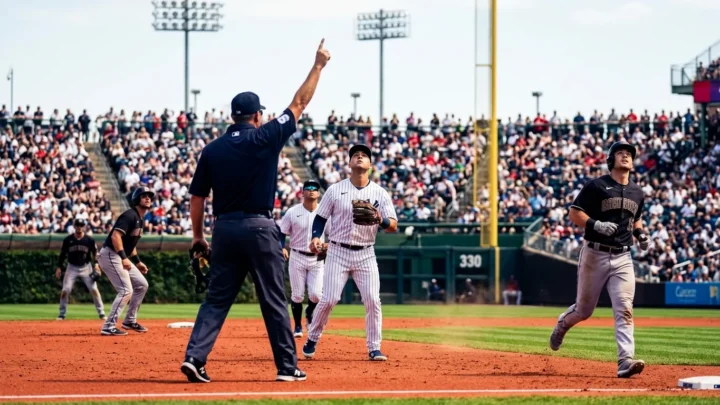
Another common misconception involves passing backward. An attacker who stands level with or behind the ball when a teammate passes is always onside, regardless of defender positions. Strikers running parallel on a breakaway can pass sideways or backward freely. Positional restrictions like this mirror the ineligible receiver downfield rule in football, where release location governs legal eligibility.
How VAR Calibrates Lines and Resolves Parallax Error
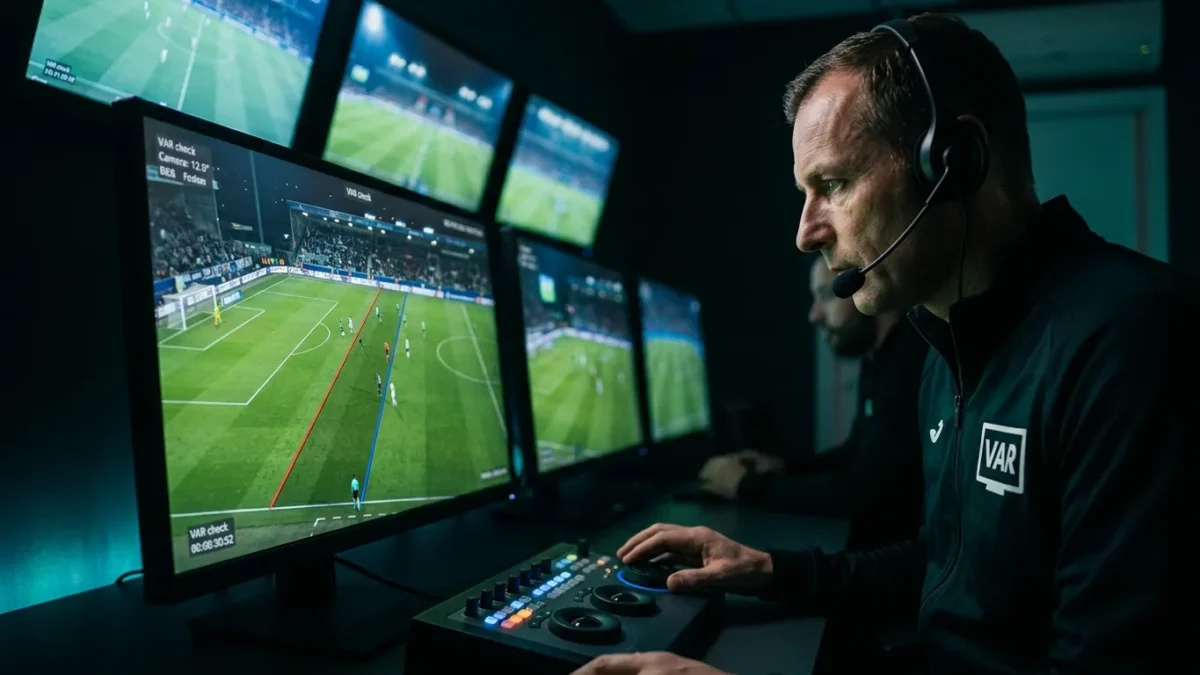
Stadium broadcast cameras frequently produce parallax error, an optical illusion where an angled view makes players appear out of alignment with the turf. A player who looks offside from an elevated midfield camera may actually stand level with the defender when viewed along the exact offside plane.
Video Assistant Referee systems resolve this distortion using calibrated virtual lines. Technicians map pitch markings and camera angles into software before the match. During reviews, officials identify the exact video frame of the passer’s contact, then project vertical lines from the furthest legal scoring points of both players down to the pitch surface.
Semi-automated systems accelerate this process with tracking cameras mounted under stadium roofs. Optical tracking monitors player body points while embedded ball chips log contact hundreds of times per second. These tools generate automated graphics, allowing officials to confirm offside calls accurately within seconds.
FAQ
Can a player be called offside from a throw-in?
No, a player cannot be called offside if they receive the ball directly from a throw-in, corner kick, or goal kick. Law 11 explicitly exempts these three restarts from offside penalties. As soon as another player touches the ball after the restart, normal offside restrictions resume.
Does the goalkeeper always count as the last defender?
No, the goalkeeper does not always count as the last defender because the rule applies to any opponent on the pitch. If the goalkeeper advances into midfield, an outfield defender nearest the goal line becomes the last opponent, and the next deepest opponent sets the offside line.
Can an attacker be offside if they stay behind the ball?
An attacker cannot be offside if they remain level with or behind the ball when a teammate passes it. The offside boundary is set by either the second-to-last opponent or the ball itself, whichever is closer to the defending goal line. Passing backward to a teammate is always onside.