The ineligible receiver downfield rule in football prohibits offensive linemen from advancing past an established buffer beyond the line of scrimmage before a forward pass crosses the neutral zone, creating an intense timing conflict on run-pass option (RPO) plays. At BoringMagazine.Co, we break down complex officiating standards across athletic competitions. Just as how the offside rule in soccer is judged relies on precise spatial boundaries, football officiating relies on strict line limits to prevent illegal advantages. Offensive linemen are trained to block forward aggressively on run plays, but passing plays require them to stay behind or near the line until the quarterback releases the ball. The rise of modern RPO schemes tests this boundary on almost every possession, forcing officials to make split-second decisions that can alter games.
How the Ineligible Receiver Downfield Rule Operates
In American football, every player on offense is classified as either eligible or ineligible to catch a forward pass when the ball is snapped. Five players on the line of scrimmage, typically the center, offensive guards, and offensive tackles wearing uniform numbers 50 through 79, are designated as ineligible receivers. Under standard football rules, these interior linemen cannot travel past the neutral zone before the quarterback throws a forward pass that travels across the line of scrimmage.
The primary intent of this regulation is to keep defenses from facing impossible coverage dilemmas. If heavy blockers could run downfield freely while a quarterback holds the ball, linebackers and safeties could not distinguish between a run and a pass. Defenders would be forced to step up to tackle approaching blockers, leaving wide receivers open behind them. By restricting where linemen can stand before a throw, the rulebook ensures defensive players have an honest opportunity to diagnose the play.
Officials monitor the line of scrimmage at the exact moment the passer releases the football. If an ineligible player crosses into the secondary before that release, the offense commits an illegal act. The timing of the throw, rather than the arrival of the ball at the receiver, determines whether a lineman has violated the boundary.
NFL vs. College Football: The Yardage Buffer Gap
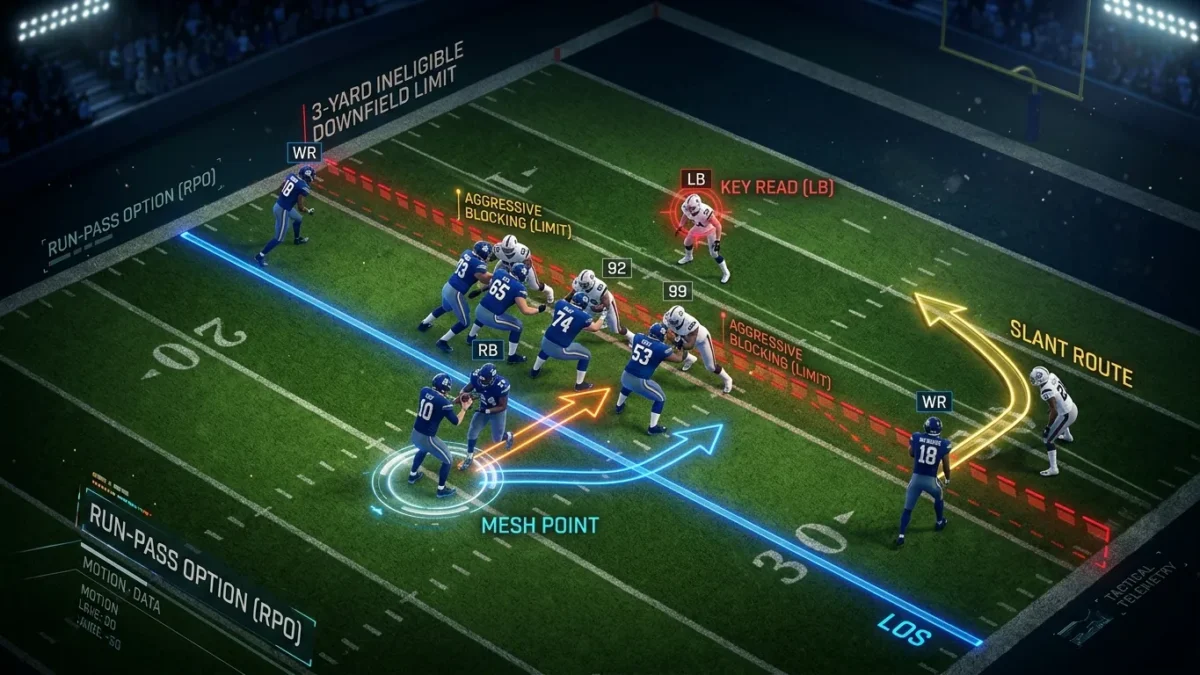
The biggest difference between professional and amateur football enforcement lies in the physical buffer zone granted to offensive linemen. In the National Football League, the rulebook strictly limits ineligible players to a one-yard buffer beyond the line of scrimmage prior to the pass. According to NFL Football Operations, line judges and down judges watch the line closely to ensure linemen do not exceed this 36-inch boundary when a forward pass crosses the neutral zone.
College football, governed by the NCAA, provides a much more generous three-yard buffer. Under NCAA Rule 7, offensive linemen can advance up to three yards downfield from the neutral zone while the pass is in flight or before release. This extra two yards represents a massive tactical advantage for college offenses. A guard or tackle can fire off the snap, push into the defensive front, and advance toward second-level linebackers without drawing a yellow flag.
Because of this difference, offensive schemes designed in college do not always translate smoothly to the professional level. An offensive tackle in a college program can take three aggressive steps forward without worry. That exact same movement in an NFL game results in a five-yard penalty and a nullified play, forcing pro offenses to operate with much tighter throwing windows.
The Tactical Conflict of the Run-Pass Option
Run-pass options, commonly known as RPOs, create direct conflict with downfield blocking rules because they combine two opposing offensive philosophies on a single snap. On a traditional pass play, offensive linemen drop back into pass protection to build a protective pocket around the quarterback. On a traditional run play, linemen surge forward aggressively, firing off the line to create running lanes and block linebackers at the second level.
An RPO calls for run blocking regardless of whether the quarterback hands the ball off or throws it. The offensive line executes an aggressive run block, driving defensive tackles backward and climbing up to block inside linebackers. Meanwhile, the quarterback reads a specific conflict defender, usually an outside linebacker or safety. If that defender crashes down against the run, the quarterback pulls the ball back and targets a receiver running a quick route into the vacated space.
The central dilemma is time. Because the offensive line is actively run blocking, those linemen are moving forward from the millisecond the ball is snapped. If the quarterback takes even two seconds to read the defense, pump fake, or reset his feet, his linemen will naturally travel three or four yards downfield. That puts the offense in immediate danger of a penalty flag if the resulting throw crosses the line of scrimmage.
Real Game Scenarios and Officiating Mechanics
On any given football weekend, officiating crews rely on strict positioning to spot illegal downfield movement. The down judge and line judge stand on opposite sidelines along the line of scrimmage, while the umpire stands in the offensive backfield or behind the linebackers. When the ball is snapped on an RPO, the sideline officials track the line of scrimmage while observing the movement of the offensive tackles. The umpire watches the interior guards and center.
Consider a practical game scenario where a team runs an inside zone RPO from the opponent’s 20-yard line. The center and right guard double-team the nose tackle and drive him back. As the right tackle climbs to block the middle linebacker at the 17-yard line, the quarterback notices the slot cornerback creeping into the tackle box. The quarterback pulls the ball and fires a slant to the slot receiver crossing at the 15-yard line. In an NFL game, because the tackle was three yards past the line of scrimmage when the pass was released, the line judge throws a penalty flag for an ineligible receiver downfield.
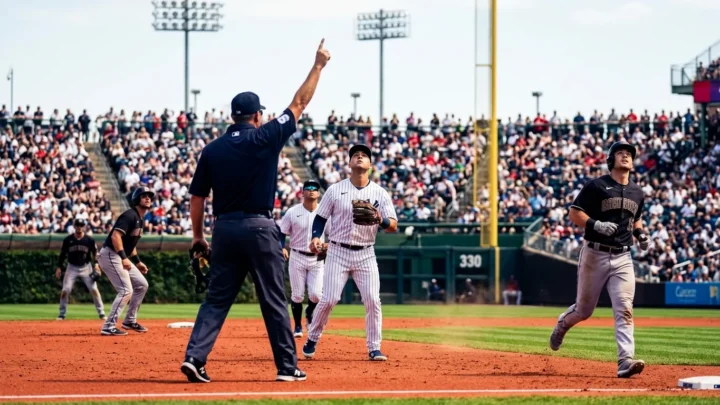
Officiating this call requires great coordination. In our sports guides, we frequently examine how split-second timing governs fair play. In the same way that umpires must judge specific runners and base states when exploring when the infield fly rule applies in baseball, football officials must track the passer’s arm, the football’s trajectory, and the lineman’s feet simultaneously.
Common Misconceptions and Rule Nuances
Many fans misunderstand how the downfield boundary functions during different passing concepts. The most frequent misconception is that offensive linemen can never be downfield on any forward throw. In reality, the ineligible receiver downfield rule applies only when a forward pass crosses the line of scrimmage. If an offense executes a quick bubble screen or smoke screen where the receiver catches the ball behind the line of scrimmage, offensive linemen can sprint as far downfield as they want before the throw without penalty.
Another common point of confusion involves continuous contact. If an offensive lineman engages a defensive lineman right at the line of scrimmage and drives him five yards into the defensive backfield, that action is legal under most rules, provided the blocker remains continuously engaged with that same defender. The penalty occurs when an ineligible player leaves that initial block and advances freely into open space before the pass is thrown.
Fans also wonder what happens if a pass is tipped at the line of scrimmage. Once a defensive player touches a forward pass, or once the pass is thrown, downfield restrictions on ineligible players end. However, if the lineman was already past the legal buffer before the ball left the quarterback’s hand, the infraction occurred before the release, meaning the penalty still stands.
FAQ
How many yards can an offensive lineman go downfield on a pass?
In the NFL, an offensive lineman can advance only one yard beyond the line of scrimmage before a forward pass that crosses the neutral zone is released, whereas college football allows a three-yard buffer. This difference means NFL quarterbacks must make their passing decisions much faster than college quarterbacks on run-pass option plays.
Does the ineligible receiver downfield rule apply to screen passes?
No, the ineligible receiver downfield rule does not apply to screen passes caught behind the line of scrimmage. Because the restriction only governs forward passes that travel beyond the neutral zone, offensive linemen can legally charge downfield to set up blocks on screen plays before the throw.
What is the penalty for an ineligible receiver downfield?
The penalty for an ineligible receiver downfield is five yards from the previous line of scrimmage and a replay of the down. While five yards may seem modest, the penalty wipes out any positive yardage or touchdown scored on the play, making it a costly setback for an offense.