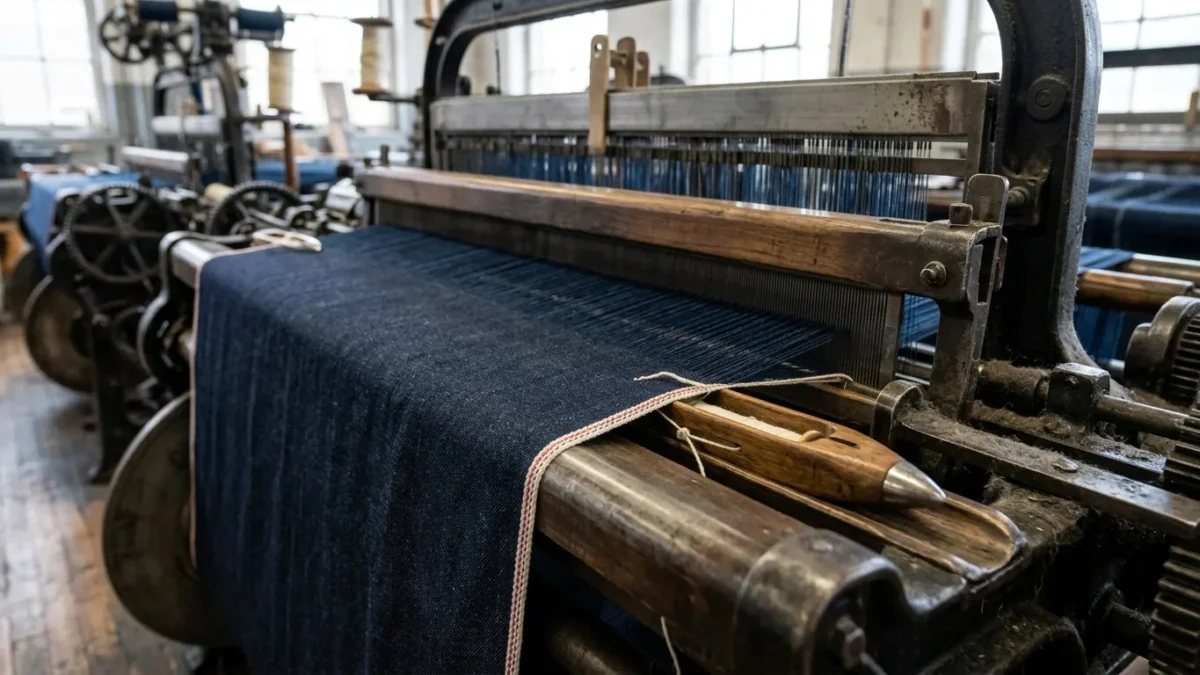
Selvedge denim is made on a shuttle loom by passing a wooden bobbin back and forth across warp yarns to create a single continuous weft thread that loops around both outer edges of the fabric. Because the weft thread never breaks or cuts at the borders, it binds each side naturally. This self-binding perimeter is known as a self-edge, or selvedge. At BoringMagazine.Co, we examine garment construction down to the individual thread to show why production machinery shapes the final product. Understanding these vintage machines clarifies why traditional jeans feel, age, and hold together differently from modern garments.
How the Shuttle Mechanism Forms a Continuous Loop
To understand how a shuttle loom creates an intact edge, you must examine the geometry of the weave. Denim is a twill weave constructed from two intersecting yarn systems. The warp consists of vertical, indigo-dyed yarns held under tension along the length of the loom. The weft consists of horizontal, undyed white yarn that travels across the warp width.
A traditional shuttle loom carries weft yarn inside a boat-shaped wooden casing called a shuttle. Inside this shell sits a quill wound with cotton thread. As the loom cycles, harnesses raise and lower alternating warp threads, opening a triangular tunnel called the shed. A mechanical picking stick strikes the shuttle, driving it across the shed from one side to the other.
When the shuttle exits on the opposite side, the harness shifts, locking the horizontal yarn in place. A heavy reed presses forward to pack the new yarn against the woven cloth. Because the weft yarn feeds continuously from the internal quill without being cut, it wraps around the outermost warp thread and heads back in the opposite direction. This continuous reversal forms a clean, self-finished border that resists fraying.
Shuttle Weaving Versus Modern Projectile Looms
Modern textile production replaced shuttle looms during the mid-twentieth century in favor of faster, wider machines. Projectile, rapier, and air-jet looms dominate commercial fabric manufacturing today. These modern machines do not drag a wooden shuttle across the warp bed. Instead, they fire individual, precut strands of yarn using small steel grippers or high-pressure air bursts.
Because projectile systems release the weft yarn after every pass, a mechanical blade trims the thread at each outer margin. This process leaves an open, frayed edge on both sides of the bolt. Denim makers must feed these cut edges through an overlock sewing machine, running a polyester chain stitch called serging to prevent the exposed horizontal threads from coming undone.
The width of the fabric also marks a major difference. Modern projectile looms weave denim at widths between 58 and 64 inches. Shuttle looms operate on a narrow frame, producing fabric rolls that measure only 28 to 32 inches across. When clothing manufacturers calculate yardage, fabric GSM helps cutters determine how the narrower, denser shuttle-woven roll will drape once sewn into jeans.
The Step-by-Step Weaving Process on a Shuttle Loom
Making selvedge denim requires a synchronized series of mechanical actions:
- Warping and Sizing: Technicians wind thousands of indigo-dyed cotton yarns onto a warp beam. These yarns receive a starch coating to protect them against friction during weaving.
- Threading the Harnesses: Each warp yarn passes through a wire heddle suspended within a harness frame. The frames move up and down to form the classic three-by-one right-hand twill structure.
- Shed Formation: The loom lifts one group of warp yarns while depressing the rest, opening a clear path through the warp sheet.
- Shuttle Flight: Picker sticks strike the shuttle, shooting it through the shed at speeds up to 200 picks per minute as yarn unwinds from the quill.
- Beat-Up and Take-Up: The reed swings forward to pack the weft pick against the cloth. The roller advances the fabric forward, tensioning the edge before the shuttle returns.
The success of this sequence depends on raw fiber quality. In our Fashion guides, we explain how cotton staple length provides the tensile strength needed to endure repeated shuttle strikes without snapping.
Historic Examples From Vintage Denim Mills
The history of shuttle-woven denim centers on specific machinery models preserved in the United States and Japan. In America, the Draper Corporation developed automatic shuttle looms that defined twentieth-century workwear. Draper X3 looms filled the White Oak plant operated by Cone Mills in Greensboro, North Carolina. For decades, Cone Mills supplied the XX selvedge denim used in Levi Strauss five-pocket jeans.
To track different fabric weights and production runs, Cone Mills wove a contrasting red yarn into the outer edge of their denim. This red stripe became the iconic redline selvedge recognized by vintage denim collectors.
When American companies transitioned to projectile looms during the 1970s and 1980s, Japanese textile makers preserved the older methods. Mills such as Kurabo and Kaihara purchased vintage Toyoda automatic looms, including the Model G and GL9. These Japanese weavers kept line speeds slow, allowing the shuttles to produce dense, textured denim edges with deep indigo hues.
Common Misconceptions About Selvedge Denim
Shoppers frequently confuse terminology when evaluating vintage-style jeans:
- Selvedge Is the Same as Raw Denim: Selvedge refers only to the woven edge structure made on a shuttle loom. Raw denim describes fabric that has not undergone washing or distressing after weaving. You can buy washed selvedge jeans, just as you can buy unwashed denim from a modern projectile loom.
- Selvedge Always Guarantees Superior Durability: The self-finished edge prevents the outseams from fraying, but overall garment strength depends on cotton quality, yarn twist, and fabric density. A poorly made shuttle denim will fail faster than well-constructed cloth from a modern loom.
- All Clean Outseams Are Genuine Selvedge: Some brands produce imitation selvedge by cutting projectile denim and stitching a strip of twill tape over the serged edge. Genuine selvedge shows real white weft threads looping cleanly around colored warp ends without extra tape.
FAQ
What is the difference between selvedge denim and regular denim?
Selvedge denim features tightly woven, self-finished outer edges produced on a shuttle loom, whereas regular denim has cut edges produced on high-speed projectile or air-jet looms that require overlock stitching to stop fraying. The shuttle loom creates an unbroken border by looping a single weft thread back into the weave. Modern regular denim cuts every horizontal yarn, leaving exposed thread ends along the entire length of the bolt.
Why is selvedge denim woven on narrower bolts than modern denim?
Selvedge denim is woven on narrow bolts because vintage shuttle looms rely on mechanical arms that can only cast a shuttle across a width of 28 to 32 inches before losing momentum. Modern projectile and air-jet looms eliminate the heavy shuttle, allowing machines to propel thread across beds measuring 60 inches or wider. Because narrow bolts provide less usable area, cutting jeans from shuttle denim requires more yardage.
Does selvedge denim always have a red line along the edge?
No, selvedge denim does not always have a red line, because mills use colored ticker yarns solely for identification and can weave lines in green, yellow, white, or no contrasting color at all. Cone Mills originally added a red thread to distinguish the denim woven for Levi Strauss from fabrics woven for other clients. Today, artisan weavers select edge thread colors as decorative signatures or leave the edge plain white.