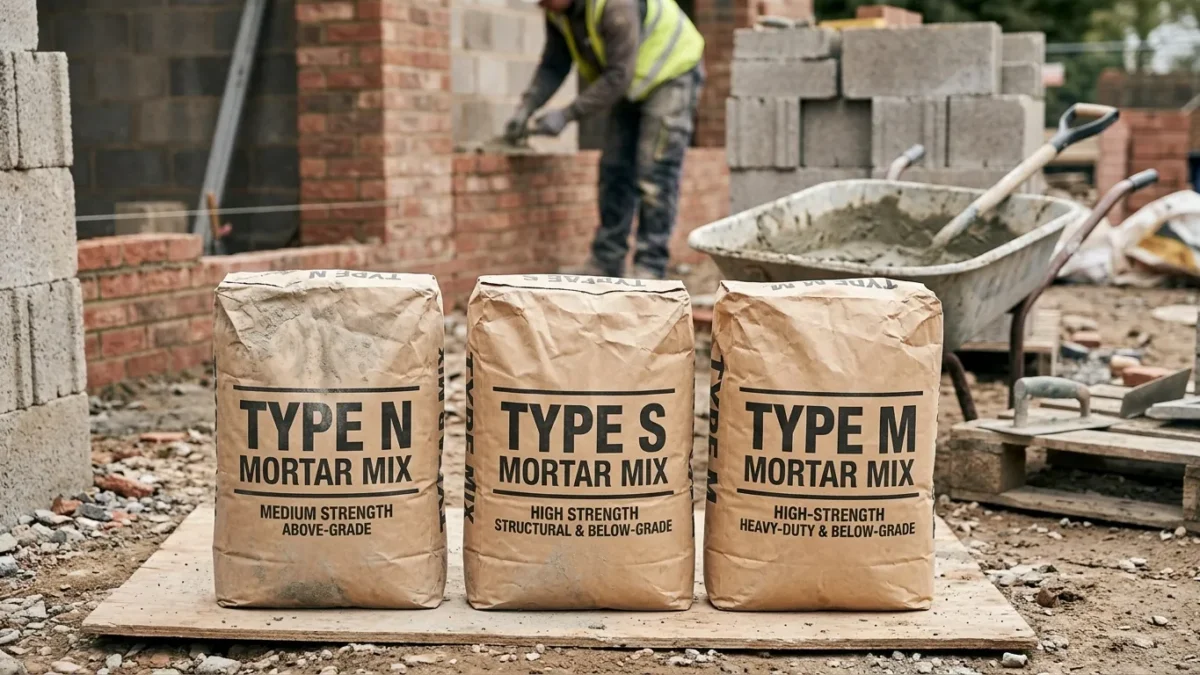
The primary difference between Type N and Type S mortar is compressive strength and flexibility: Type N mortar achieves a moderate compressive strength of roughly 750 pounds per square inch (psi) with higher lime content for superior workability and flexibility, while Type S mortar delivers a higher compressive strength of about 1,800 psi designed for structural, load-bearing, or below-grade masonry.
At BoringMagazine.Co, we focus on the practical physics of residential construction. Mortar acts as a stabilizing cushion that distributes weight evenly across irregular masonry units. When builders choose a mix, they balance load capacity against elastic flexibility. Selecting the wrong mix can crack brittle bricks or trap moisture inside a wall assembly.
Understanding Mortar Classifications and How Mortar Works
Mortar mixes in modern building codes follow standards set by ASTM International under standard C270. This specification outlines four primary mortar types: Type M, Type S, Type N, and Type O. The naming convention originates from alternating letters in the phrase “MaSoN wOrK.”
Standard mortar contains four main ingredients, each providing a specific mechanical property:
- Portland Cement: Provides rapid curing, compressive strength, and water resistance.
- Hydrated Lime: Imparts plasticity, water retention, elasticity, and autogenous self-healing that allows microscopic cracks to reseal.
- Masonry Sand: Serves as aggregate, controlling shrinkage as the paste dries.
- Water: Activates the chemical hydration of cement and lime.
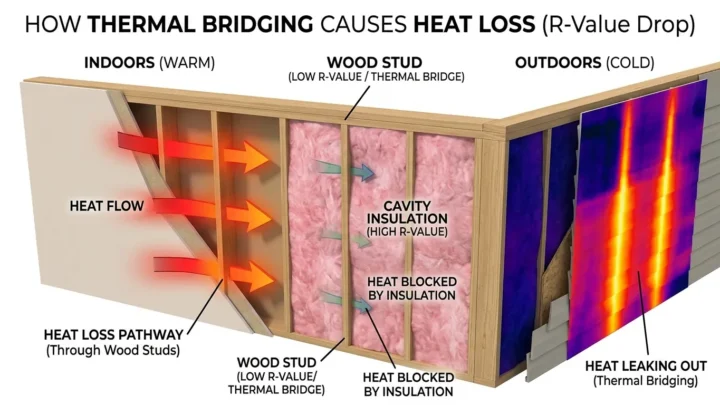
The proportion of Portland cement to hydrated lime determines whether a mortar cures into a rigid joint or a flexible bond. Understanding this balance helps homeowners maintain assemblies properly, just as understanding thermal bridging in insulation protects building envelopes from temperature swings.
Compressive Strength and Ratios Across Types N, S, and M
The performance of masonry mortar depends on its 28-day compressive strength, measured in pounds per square inch. ASTM C270 defines these strength profiles through volumetric proportions:
- Type N Mortar: Blends 1 part Portland cement, 1 part hydrated lime, and 5 to 6 parts sand. It yields a minimum compressive strength of 750 psi at 28 days, balancing bond strength with elastic recovery.
- Type S Mortar: Blends 2 parts Portland cement, 1 part hydrated lime, and 7 to 9 parts sand. It develops a minimum compressive strength of 1,800 psi. Its reduced lime ratio creates a stiff mortar suitable for high wind exposure and heavy loads.
- Type M Mortar: Blends 3 parts Portland cement, 1 part hydrated lime, and 9 to 12 parts sand. It achieves a minimum compressive strength of 2,500 psi, formulated for heavy compression and continuous moisture.
As the ratio of Portland cement increases relative to lime, compressive strength rises while elasticity drops. High-strength mixes dry faster and resist heavy compression, while Type N accommodates minor structural movement without shearing.
Lime Flexibility and Preventing Spalling in Older Bricks
A primary rule of masonry preservation states that the mortar joint must always be softer and more vapor-permeable than the surrounding masonry units. If mortar cures harder than the adjacent brick, building settlement concentrates stress directly into the brick rather than the joint.
Bricks made before the early twentieth century were fired in kilns at lower temperatures than modern bricks. These historic units have soft clay cores and delicate surface skins. When moisture penetrates older walls, it must evaporate through the mortar joints. Because hydrated lime creates high vapor permeability, softer mortar acts as a wick that pulls moisture outward.
When modern Type S or Type M mortar is used to repoint historic brickwork, moisture becomes trapped inside the brick. During winter freezing cycles, trapped water expands into ice. Unable to escape through the dense Portland cement joint, the freezing water shatters the outer face of the brick. This destructive failure is known as surface spalling. Once the outer skin pops off, the inner clay rapidly disintegrates.
Mortar must serve as a sacrificial element. Grinding out and repointing soft mortar joints every fifty years is far cheaper than rebuilding walls destroyed by shattered brick faces.
Selecting the Correct Mortar for Real Masonry Projects
Choosing the correct mix requires evaluating whether an installation is above or below grade, interior or exterior, and load-bearing or decorative. In our Home Improvement guides, we match material specifications to environmental stresses.
Use these guidelines for standard residential projects:
- Exterior Brick Veneer: Type N is the primary choice for above-grade exterior walls. It accommodates normal wind loads, expands during temperature changes, and bonds cleanly to modern clay brick.
- Chimneys and Parapets: Type N works well for sheltered chimneys, but Type S is standard for exposed roof chimneys subject to driving rain and heavy winds.
- Retaining Walls and Foundation Blocks: Type S is the standard choice for retaining walls and below-grade concrete masonry units that resist soil pressure and moisture.
- Footings and Heavy Paving: Type M is reserved for continuous subgrade contact, foundation pilings, and stone paving subjected to heavy loads.
- Historic Restorations: Historic brick built before 1930 usually requires Type O mortar (around 350 psi) or pure lime putty with no Portland cement.
Common Mistakes and Misconceptions in Mortar Selection
The most widespread misconception among property owners is that stronger mortar always produces a stronger wall. Homeowners often buy Type S or Type M because the packaging says “high strength,” assuming it provides superior protection for a garden wall or brick walkway. In masonry, excessive hardness causes cracking.
Another frequent error occurs during tuckpointing, which involves grinding out decayed mortar and packing fresh mortar into joints. Masons must rake out old joints to a depth of at least twice the joint width to create a mechanical key. Packing a thin layer of hard Type S over powdery lime mortar causes rapid delamination, as the new layer soon peels away.
Improper water mixing also damages batch quality. Adding extra water to restore workability to drying mortar, a practice called retempering, dilutes the cement paste and lowers compressive strength. Mixes should only be retempered within the first two hours after mixing.
For complex structural repairs or historic facade restoration, consult a licensed structural engineer or professional preservation mason before purchasing materials.
FAQ
Can you use Type S mortar instead of Type N for above-grade walls?
You can use Type S mortar for above-grade exterior walls that require extra load-bearing strength or high wind resistance, but it is too rigid for soft historic brickwork. Modern commercial structures often utilize Type S on concrete block assemblies for sheer strength, whereas residential clay brick veneer performs better with flexible Type N joints.
Why is mortar designed to be weaker than the surrounding brick?
Mortar is designed to be weaker than the surrounding brick so that natural structural settlement and thermal expansion cause cracks in the joints rather than through the brick units. Repairing hairline cracks in mortar joints via repointing is simple and affordable, while replacing fractured bricks requires costly structural rebuilding.
What happens if you use Type M mortar on standard exterior brick veneers?
Using Type M mortar on exterior brick veneers often leads to wall failure and moisture damage because its extreme rigidity cannot absorb normal thermal movement. The lack of elasticity causes bond failure along the brick edges, creating hairline gaps where wind-driven rainwater enters the wall cavity and promotes indoor mold or winter spalling.