Hybrid icing in hockey works by allowing linesmen to blow the whistle for icing when a defending player reaches the end-zone faceoff dots before an attacking opponent after a puck is shot from behind the center red line. This system blends the safety of an automatic stoppage with the competitive excitement of a footrace. At BoringMagazine.Co, we break down sports rules so fans can follow every whistle with confidence. For more clear breakdowns of timing and positioning rules, explore our Sports guides.
Icing stops the game and moves the puck deep into the defensive zone of the team that shot it. In professional hockey, the offending team cannot substitute skaters before the next faceoff. That rule turns an errant dump-in into an exhausting defensive shift against fresh opponents.
The Mechanics of Hybrid Icing and the Faceoff Dots
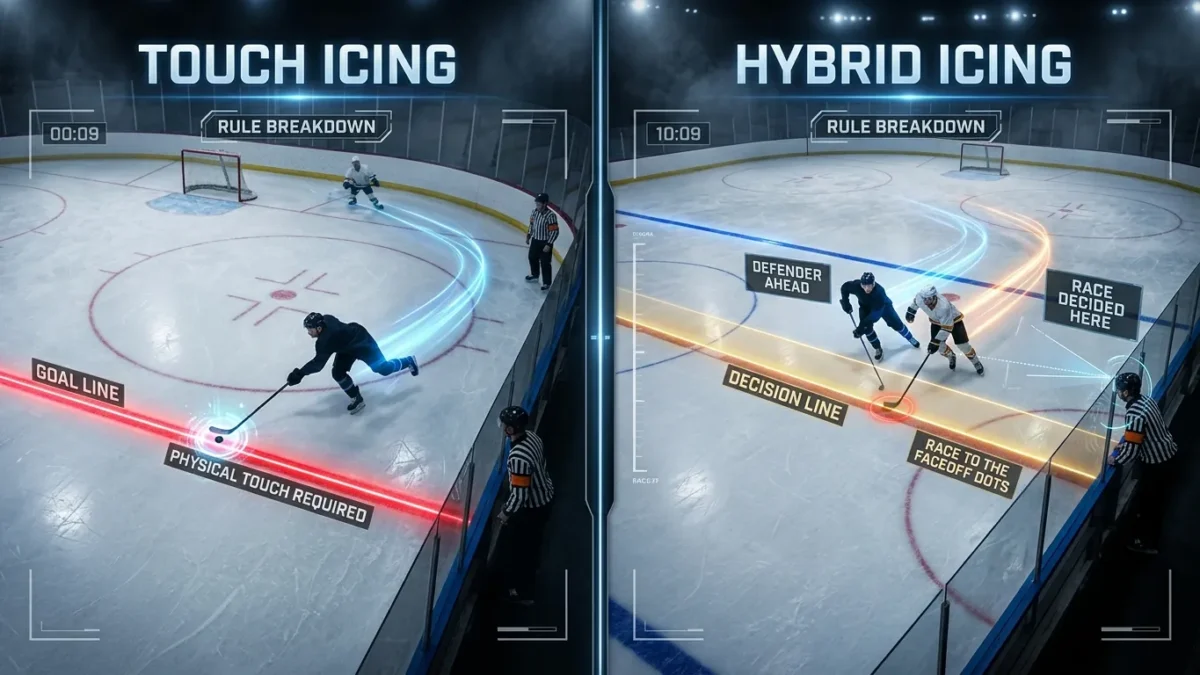
The rule relies on two checkpoints on the rink: the center red line and an imaginary line across the defensive faceoff dots. When a player dumps or shoots the puck from behind the red center line, the trailing linesman raises an arm to signal potential icing. The puck must travel across the opposing red goal line without being touched by any skater.
While the puck travels toward the end boards, players race down the ice. The linesman watches the skaters rather than the puck. As the leading skater reaches the imaginary horizontal line connecting the two end-zone faceoff dots, the official makes a judgment call.
If the defending skater reaches the dots first, or if the race is tied, the linesman blows the whistle the instant the puck crosses the goal line. Play stops, and the faceoff returns to the offending team’s defensive zone. If the attacking player reaches the dots first, the linesman waves off the call. Play continues without interruption.
Hybrid Icing vs. Touch Icing: Key Differences
To understand hybrid icing, it helps to review the three variations used in hockey history:
- Touch icing: Under touch icing rules, play stayed live until a player touched the puck behind the goal line. Defenders and chasing forwards skated at full speed into the end zone, fighting for position inches from the boards.
- No-touch icing: Also called automatic icing, this rule stops play the moment the puck crosses the red goal line. The footrace is removed entirely. Amateur leagues and international tournaments often prefer this rule.
- Hybrid icing: This rule blends both approaches. It keeps the race for the puck, but relocates the finish line to the faceoff dots instead of the end boards.
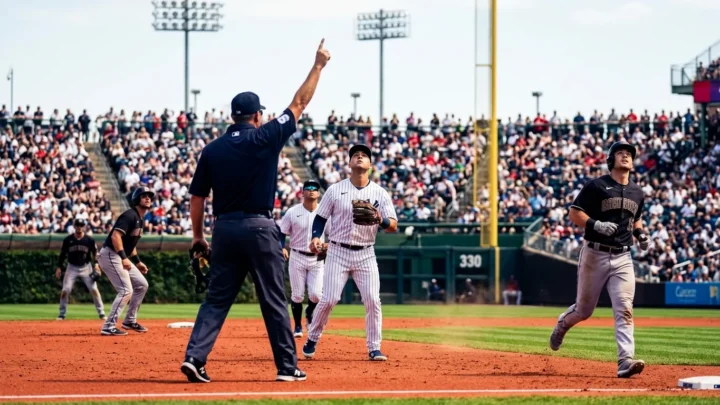
Much like when the infield fly rule applies in baseball to prevent high-risk collisions and defensive manipulation, hybrid icing removes dangerous situations while protecting the flow of play.
Step-by-Step Breakdown of a Hybrid Icing Call
A standard hybrid icing sequence follows a clear set of events:
- The puck release: A skater shoots or deflects the puck from behind the center red line.
- The signal: The back linesman raises an arm straight up to signal potential icing.
- The sprint: Opposing players race toward the attacking zone while the front linesman tracks their position relative to the faceoff dots.
- The decision point: When the lead skater reaches the dots, about 31 feet from the end boards, the linesman judges who would reach the puck first.
- The whistle or wave-off: If the defender leads, the official blows the whistle once the puck crosses the goal line. If the attacker leads, the official waves off the call.
- The restart: On a confirmed icing, the faceoff occurs in the offending team’s end, and that team cannot change skaters.
Why Hockey Switched from Touch Icing to Hybrid Icing
Player safety drove the switch to hybrid icing. For decades, the NHL used touch icing, which created exciting footraces. However, those races caused severe injuries. Players skating at twenty miles per hour frequently crashed into the end boards after minor bumps or lost edges.
A major incident occurred in March 2008 when defenseman Kurtis Foster suffered a broken femur during a touch icing race. Later, in April 2013, Carolina Hurricanes defenseman Joni Pitkanen shattered his heel in another crash on an icing play. That injury ended Pitkanen’s NHL playing career.
Following player discussions and trials in the American Hockey League, the NHL adopted hybrid icing for the 2013-2014 season. Moving the decision point about 31 feet out from the end boards gives skaters enough room to slow down safely.
Common Mistakes and Misconceptions About the Rule
Even longtime fans occasionally misunderstand how officials apply hybrid icing during fast action.
First, some assume the whistle blows the moment a defender reaches the dots. The linesman makes the decision at the dots, but the whistle sounds only after the puck crosses the red goal line. If the puck stops short on its own, the play stays live.
Second, fans often wonder why an icing is waved off when a goaltender moves. If a goaltender leaves the crease or makes a motion to play the puck, the linesman waves off the call immediately. Goaltenders cannot pretend to play the puck to disrupt a play.
Third, fans sometimes think ties go to the attacker. In hybrid icing, any tie favors the defense and triggers a whistle. Officials prioritize safety whenever two skaters arrive at the dots together.
Just as understanding how the offside rule in soccer is judged requires watching the second-to-last defender and the ball, watching hybrid icing requires tracking player speed, the red line, and the faceoff dots.
FAQ
Can a goaltender cancel a hybrid icing call?
Yes, a goaltender cancels a hybrid icing call by leaving the goal crease or making an active motion to play the puck. Once the goalie indicates an intent to play the puck, the linesman waves off the icing signal. Play continues without a defensive zone faceoff.
What happens if the race to the faceoff dots ends in a tie?
If the race to the faceoff dots ends in a tie, the linesman calls icing and stops play. Officials prioritize safety whenever two players reach the dots simultaneously. This standard prevents high-speed collisions near the end boards.
Can a team commit icing while playing shorthanded?
No, a team playing shorthanded on a penalty kill cannot commit icing under NHL rules. Shorthanded teams may clear the puck down the full length of the rink without a whistle. Standard hybrid icing rules resume as soon as the penalty expires.