Tire speed ratings indicate the maximum sustained speed a tire can safely carry its designated load without structural failure caused by thermal buildup. Drivers often assume these ratings only matter on high-speed racetracks. In truth, the rating indicates how well a tire dissipates heat, maintains shape, and handles mechanical stresses at ordinary highway velocities. At BoringMagazine.Co, we study the engineering details that keep everyday vehicles running reliably. When choosing replacement tires or consulting our Automotive guides, knowing how tire speed ratings work helps you protect your vehicle handling and safety margins.
How Indoor Drum Testing Establishes Speed Ratings
Engineers evaluate tire speed capability using indoor laboratory test machines rather than open highway testing. Standardized protocols, including United Nations Economic Commission for Europe (ECE) Regulation 30 and standards overseen by the National Highway Traffic Safety Administration, ensure repeatable results without weather interference.
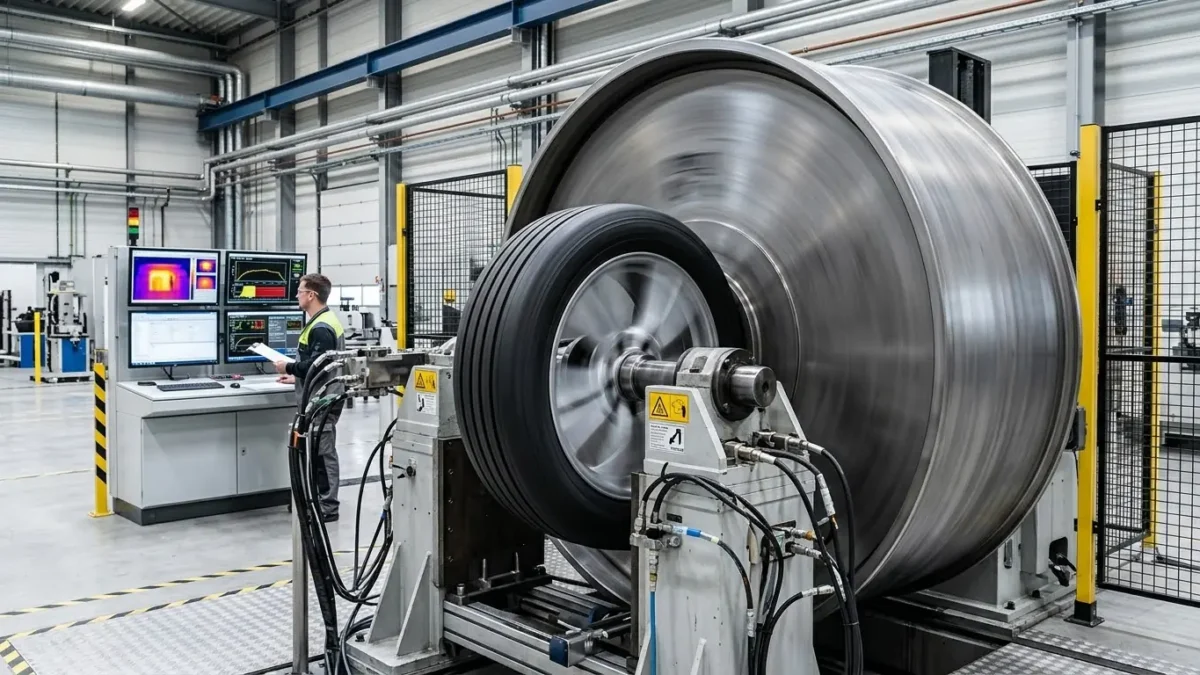
The technician mounts the tire to a steel wheel, sets it to target inflation pressure, and presses it against a steel drum measuring 1.7 meters (about 67 inches) in diameter. An automated arm applies a mechanical load equal to 80 to 85 percent of the tire maximum load capacity. The test takes place in a temperature-controlled room held around 38 degrees Celsius (100 degrees Fahrenheit) for US testing or 25 degrees Celsius (77 degrees Fahrenheit) for European testing.
The machine follows an incremental speed schedule:
- Warm-up period: The drum rotates the loaded tire at moderate speeds for two hours to stabilize casing temperatures.
- Initial speed step: The machine accelerates to 20 km/h (12.4 mph) below the target rating for ten minutes.
- Incremental increases: The drum speed increases in 10 km/h (6.2 mph) steps every ten minutes until reaching the designated rating.
- Sustained duration: The tire must spin at its target speed for ten to thirty continuous minutes without tread separation, carcass distortion, or pressure loss.
After the test stops, technicians inspect the tire for internal separation or bead damage. Any cracking, chunking, or pressure drop results in a failure.
Thermal Buildup and Why High-Speed Tires Fail
Heat generation represents the greatest physical challenge for a spinning tire. As a tire rolls, the tread and sidewall flex where they meet the road surface. This contact area compresses and relaxes with every single wheel revolution. This constant movement creates internal friction within the rubber polymers and fabric cords, a mechanical process known as hysteresis. Hysteresis converts kinetic energy into internal heat.
At highway speeds, the rotation rate multiplies rapidly. A typical car tire rotates more than 800 times every mile, which translates to roughly 20 to 25 rotations per second at higher highway speeds. When heat builds faster than the tread grooves and sidewalls can radiate it into the air, internal temperatures climb rapidly.
If internal temperatures climb past 120 degrees Celsius (248 degrees Fahrenheit), the rubber begins to soften and tensile strength drops. Extreme temperatures also degrade the adhesive skim coats bonding the internal belts together. At the same time, centrifugal forces pull outward against the tread. If heat weakens the internal bond while centrifugal force pulls the tread away, the tire experiences catastrophic tread separation.
Decoding Sidewall Ply Markings and Cap-Ply Construction
You can find the structural makeup of your tire molded directly on the sidewall. A typical sidewall listing reads: Tread Plies: 2 Polyester + 2 Steel + 1 Polyamide; Sidewall Plies: 2 Polyester. These markings reveal the exact materials holding the tire carcass together.
The tire structure relies on distinct internal layers:
- Body plies: Layers of rubber-coated polyester or rayon cords run radially from bead to bead to contain air pressure and support vehicle weight.
- Steel belts: Crossed bands of braided high-tensile steel wire lie underneath the tread to provide puncture resistance and keep the tread flat.
- Cap plies: Also called spiral overlays, these layers consist of nylon (polyamide) or aramid cords wrapped circumferentially over the steel belts.
Cap plies represent the main design feature separating higher speed ratings from basic ratings. Under strong centrifugal force, the edges of steel belts try to flare outward. Nylon cap plies solve this problem because nylon shrinks slightly when exposed to heat. As operating temperatures rise, the cap ply tightens around the steel belts, resisting centrifugal lift and keeping the contact patch stable.
Speed Rating Letter Chart and Vehicle Demands
A tire speed rating appears as the final letter in the service description, located adjacent to the load index. Common automotive ratings establish clear operational limits:
- S and T: Rated for 112 mph and 118 mph, typical for standard passenger sedans, minivans, and small pickup trucks.
- H: Rated for 130 mph, common on midsize family sedans, small SUVs, and sporty coupes.
- V: Rated for 149 mph, standard equipment on sports sedans and performance crossovers.
- W and Y: Rated for 168 mph and 186 mph, engineered for sports cars and high-output performance models.
Matching the correct rating to your vehicle matters even if you never drive near maximum limits. Modern electric and hybrid vehicles carry substantial weight from battery packs, placing extra stress on tires during acceleration and braking. Choosing the proper tire rating complements vehicle dynamics just as effectively as understanding how hybrid cars blend regenerative and friction braking. In sports vehicles, stiffer high-speed casings maintain lateral grip during aggressive cornering, working alongside hardware like how a limited-slip differential distributes torque across the drive wheels.
Common Speed Rating Mistakes and Misconceptions
A widespread misconception is that speed ratings only serve drivers who break the speed limit. In practice, higher speed ratings feature stiffer sidewalls and specialized tread compounds that improve steering response and emergency braking grip at legal speeds. Downsizing to a lower speed rating can make vehicle handling feel sluggish or vague.
Another dangerous mistake involves ignoring tire inflation. Speed ratings assume proper cold tire pressure. An underinflated tire flexes excessively, creating severe internal heat at 70 mph that matches the heat generated at 120 mph on a properly inflated tire. Driving on underinflated tires negates the safety margin of any speed rating.
Vehicle owners should also avoid mixing tires with different speed ratings on the same car. Placing lower-rated tires on one axle alters front-to-rear stiffness balance, which can trigger unexpected oversteer or understeer during sudden avoidance maneuvers. Finally, repairing a punctured high-speed tire often voids its official rating because steel belt integrity has been compromised. If you have questions about tire damage or casing integrity, consult a certified tire professional.
FAQ
Can you put a lower speed-rated tire on your car?
You should avoid installing tires with a lower speed rating than the vehicle manufacturer specified on the tire placard. Installing lower-rated tires can compromise high-speed stability, degrade steering precision, and increase heat-related failure risks. The only common exception is using dedicated winter tires, where drivers may select a slightly lower rating provided they observe reasonable speed boundaries.
Does a higher tire speed rating mean the tire wears out faster?
Higher speed-rated tires often wear out faster because they use softer rubber compounds to generate traction and dissipate heat. Softer rubber formulations improve road adhesion and maintain elasticity under high thermal loads, but they experience faster physical abrasion. Touring tires with lower speed ratings prioritize mileage life over high-temperature endurance.
What does the ply description on the tire sidewall signify?
The ply description lists the exact number and material composition of the structural cord layers running through the tread and sidewall. It shows whether the tire contains polyester, steel, or polyamide reinforcement. This information verifies the internal strength of the casing and confirms whether specialized cap plies are present to control high-speed expansion.